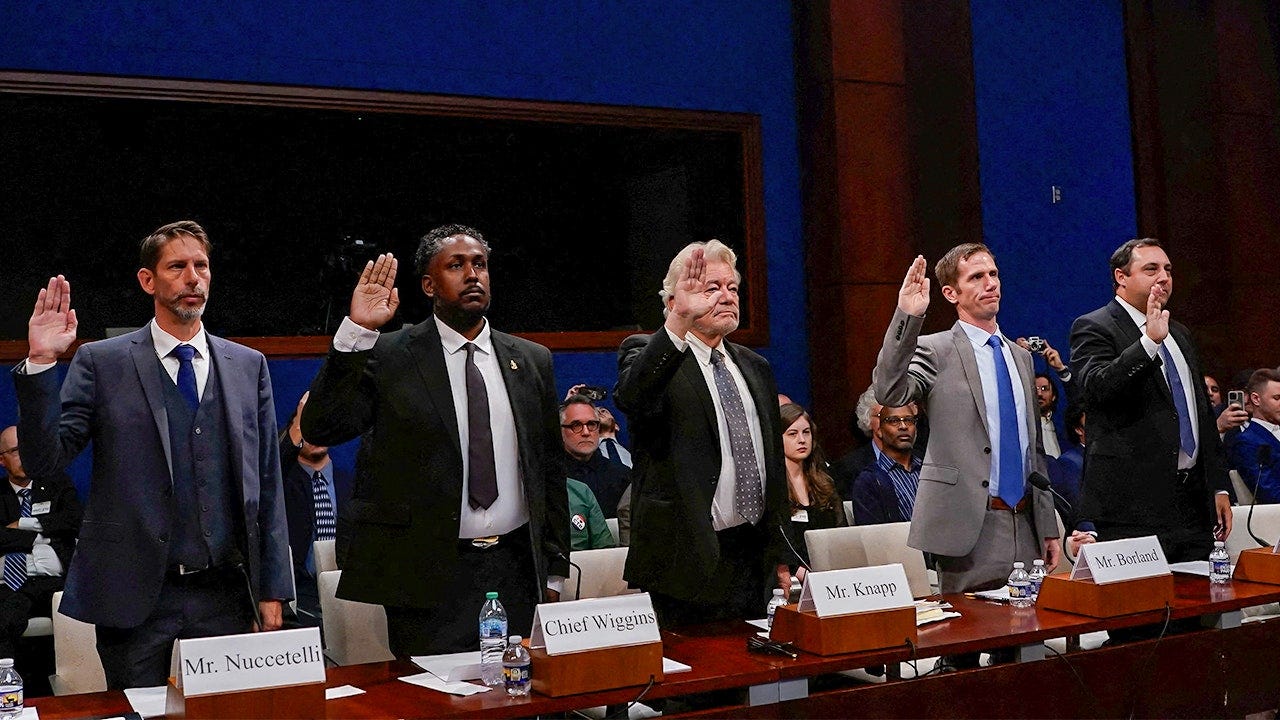
Congressional UFO hearing, lost in the news cycle.
A watershed, task force hearing on UFO/UAP, that you probably didn't know about.

This hearing was largely overshadowed by high-profile news events at the time, and as a result, received minimal international attention. This article aims to bring it back into focus for those following the pursuit of disclosure.
Given the breadth of the hearing and the implications, I cannot cover this all in a substack article due to length limitations, so this is a concise overview designed as a starting point for further examination. It is structured clearly and chronologically so that readers, even without prior background, can follow the testimony and referenced material in context. All details are drawn directly from the official transcript and supporting sources.
A glossary of terms and acronyms is provided in alphabetical order, together with links to relevant external pages for additional context, and a list of speakers and their roles is included at the end. The full government hearing video, the complete transcript and supporting documents are linked, with timestamps added to assist navigation through the unedited footage.
You now have all of my source material. I hope you enjoy.
On 9 September 2025, members of the U.S. House Committee on Oversight and Accountability convened a hearing titled Restoring Public Trust Through UAP Transparency and Whistleblower Protection. It was a formal session of Congress examining classification, oversight authority and the legal protection of individuals claiming knowledge of concealed programmes related to unidentified anomalous phenomena.
Lawmakers sought clarity on whether information concerning UAP investigations, historical programmes and alleged legacy efforts had been improperly withheld from Congress and the public. Witnesses were called to describe their experiences within military and investigative environments. Members questioned whether current secrecy structures, including Special Access Programs and compartmented reporting channels, had prevented lawful oversight. The issue at stake was not simply the existence of unexplained objects in restricted airspace, but whether the mechanisms of classification and national security had been used in a manner consistent with constitutional accountability.
How to support my work
Buy My Books. Paperback, Kindle and Kindle Unlimited:
The session unfolded under the authority of a specialised task force created to examine the declassification of sensitive federal records. Testimony addressed whistleblower protections, Inspector General processes, access to SCIF briefings and the scope of information available to elected representatives. The underlying theme was institutional trust. If anomalous encounters have been recorded across multiple domains, and if personnel fear retaliation for reporting what they know, then the problem extends beyond aviation safety into democratic governance.
Despite the gravity of its subject matter, the hearing passed with minimal public awareness. It occurred during a period dominated by fast-moving international developments that captured global media attention and displaced congressional coverage from national headlines. As a result, a formal discussion about secrecy, oversight and the handling of anomalous intelligence records unfolded largely outside the wider public conversation.
The Witnesses
Jeffrey Nuccetelli β Former U.S. Air Force military police officer with 16 years of active-duty service, stationed at Vandenberg Air Force Base during multiple reported UAP incursions between 2003 and 2005.
Opening Statement - paraphrased
Video Timestamp Link 33:46
Nuccetelli said he testified because he believes the public has a right to the truth about UAP and that the issue has been constrained by classification, stigma and fear of retaliation. He described five incidents at Vandenberg Air Force Base between 2003 and 2005 during high-priority National Reconnaissance Office launches tied to the National Missile Defence Project. According to his account, multiple personnel witnessed the events, reports were filed up the chain of command and no guidance returned.
On October 14, 2003, Boeing contractors reported a glowing red square hovering over missile defence sites before drifting and vanishing. He said official records are held by AARO and the FBI. Later that night, guards reported a fast-moving object from the ocean, followed by a large triangular craft hovering over an entry control point for roughly 45 seconds before departing at extreme speed. About a week later, another patrol reported an erratic light descending to the flightline and accelerating away, after which witnesses were warned to remain quiet. Activity resumed around 2005 with another triangular craft sighting, and he described his own encounter with a pulsing light that manoeuvred irregularly, reappeared as a roughly 30-foot sphere about 200 feet above his house and accelerated out of sight.
He urged Congress to treat UAP as a serious subject through independent research, reduced overclassification and stronger witness protections, arguing that a transparent investigation could have broader scientific implications.
Alexandro Wiggins β Active duty U.S. Navy Operations Specialist and Senior Chief Petty Officer assigned to USS Jackson, responsible for surface and air picture management within ICC-1 during multi-sensor tracking operations.
Opening Statement - paraphrased
Video Timestamp Link: 40:02
Wiggins testified in his personal capacity about a February 15, 2023, incident in the Whiskey 291 warning area off southern California while serving aboard USS Jackson. While correlating sensor and visual data between ICC-1 and the bridge wing, he observed and recorded a self-luminous tic-tac-shaped object emerge from the ocean and join three similar objects. The four departed simultaneously with near-instantaneous acceleration. He reported no sonic boom, no visible propulsion or exhaust plume and no control surface articulation on the SAFIRE system. Radar tracks dropped shortly after departure, and he emphasised that the event was multi-sensor and recorded with time and location overlays.
He said unidentified objects repeatedly appear in U.S. operating areas off southern California and argued this warrants systematic, stigma-free reporting and preservation of sensor data for safety and intelligence analysis. Framing the issue as aviation and maritime safety, he called for standardised procedures to capture infrared settings, range and altitude data and proper chain of custody for recordings.
He urged Congress to strengthen protections for service members reporting such encounters and to support declassification of metadata-preserved sensor excerpts where security permits, asking lawmakers to ensure evidence is captured, protected and fairly evaluated through safe reporting channels.
George Knapp β Chief Investigative Reporter at KLAS-TV Las Vegas with nearly four decades of reporting on classified aerospace programmes, UAP investigations and government disclosure.
Opening Statement - paraphrased
Video Timestamp Link: 45:29
Knapp said he has covered the UAP issue since 1987 strictly as a journalist, describing it as a long-running national security story. He defended whistleblowers, arguing they often face reputational damage, professional harm and extra-legal retaliation that is difficult to address through formal protections.
He said his interest deepened through documents obtained under the Freedom of Information Act, which he argued contradict decades of public assurances. According to Knapp, internal military and intelligence records acknowledge that unidentified craft demonstrate formation flight, evasive manoeuvres and performance beyond known aircraft capabilities.
He referenced early reporting on Bob Lazarβs claims of reverse engineering near Area 51 and interviews with former senators and defence contractors. He highlighted the Defence Intelligence Agencyβs Advanced Aerospace Weapon System Applications Program, initiated by Dr James Lacatski, describing it as the largest acknowledged U.S. government UAP programme, much of which remains unreleased.
Knapp also stated that contractor Robert Bigelow, through BAASS, sought to obtain and study alleged crash-retrieved materials, including negotiations with Lockheed Martin over unusual materials reportedly not manufactured domestically. He further described documents obtained in the early 1990s from Russian defence officials indicating that the USSR conducted a large-scale classified investigation, collecting thousands of reports and later analysing them under a programme known as Thread III in an effort to develop advanced technology.
Dylan Borland - U.S. Air Force military police officer with 16 years of active-duty service, including assignment at Vandenberg Air Force Base during reported UAP incidents.
Opening Statement - paraphrased
Video Timestamp Link: 53:22
Dylan Borland testified under oath as a former U.S. Air Force 1N1 Geospatial Intelligence Specialist who served from 2010 to 2013 and later worked as a senior analyst for BAE Systems and Intrepid Solutions, specialising in radar and advanced electro-optical imagery analysis for aerial, naval and ground order of battle identification.
He described himself as a federal whistleblower who has testified to both the Intelligence Community Inspector General and AARO, claiming firsthand knowledge of craft and technologies not of U.S. origin operating without congressional oversight. He said that because of his knowledge of legacy crash retrieval programmes, his career was deliberately obstructed and he faced sustained retaliation.
Borland recounted a 2012 incident at Langley Air Force Base in which he observed an approximately 100-foot equilateral triangular craft near a NASA hangar at around 0130 hours. The object interfered with his phone, emitted no sound, appeared fluid in structure and ascended rapidly without visible propulsion or wind disturbance.
He further testified that while serving within a special access programme, he was exposed to classified information relating to a crash retrieval effort. After raising concerns in 2023, he said he experienced clearance manipulation, employment obstruction and professional isolation. He stated he remains effectively blacklisted within parts of the intelligence community and was questioned during a counterintelligence polygraph about what he disclosed.
He urged Congress to protect whistleblowers and act on what he characterised as evidence of a UAP reality with significant implications.
Joe Spielberger β Senior Policy Counsel at the Project on Government Oversight, a nonpartisan watchdog organisation focused on whistleblower protections, government accountability and national security oversight.
Opening Statement - paraphrased
Video Timestamp Link: 1:00:05
Spielberger testified on the need to strengthen whistleblower protections, particularly in national security contexts. He described whistleblowers as essential to congressional oversight, enabling exposure of waste, fraud, abuse of power and corruption. He noted that presidents of both parties have at times taken hostile approaches because disclosures can cause political damage, yet whistleblowers remain vital across administrations.
He characterised national security whistleblowing as a longstanding American tradition influencing debates over executive authority, transparency, civil liberties and the publicβs right to know. He emphasised the personal risks involved, including job loss, retaliatory investigations, lawsuits, criminal charges and psychological harm.
Spielberger argued that retaliation damages institutions by fostering fear, suppressing dissent and allowing misconduct to persist. He warned that whistleblowing has become increasingly politicised and urged Congress to focus on evidence, strengthen legal protections, hold retaliators accountable and ensure meaningful avenues for redress.
He concluded by calling for continued bipartisan support for whistleblower protections to restore public trust and strengthen accountability.
The hearing
Jeffrey Nuccetelli testified that between 2003 and 2005, five incidents occurred at Vandenberg Air Force Base during major National Missile Defence launches. Personnel observed anomalous activity, reports were filed, and no guidance returned.
On October 14, 2003, Boeing contractors reported a glowing red square hovering over missile defence sites before drifting east and vanishing. Later that night, security personnel described a fast-moving object from the ocean, followed by a large triangular craft hovering silently over an entry control point before departing at speed. He said official records of at least one incident are held by AARO and the FBI. About a week later, another patrol reported an erratic light descending toward the flightline and accelerating away, after which witnesses were warned about reporting it. In 2005, he described a luminous object seen from his backyard that manoeuvred irregularly, reappeared as a roughly 30-foot sphere and accelerated upward out of sight.
Alexandro Wiggins described a February 2023 incident aboard USS Jackson while working inside ICC-1. A self-luminous tic-tac-shaped object emerged from the ocean, joined three similar objects and departed simultaneously with near-instantaneous acceleration. No propulsion signature or sonic boom was observed, radar tracks dropped, and the event was recorded across multiple sensors with time and location overlays visible. He framed the matter as aviation and maritime safety and called for standardised data capture and protected reporting.
Dylan Borland described a 2012 sighting at Langley Air Force Base in which a white light manifested into a triangular craft about 100 feet above ground. It emitted no sound, interfered with his phone and ascended rapidly without visible propulsion. He later testified that within a special access programme, he became aware of what he characterised as a legacy crash retrieval effort. After raising concerns, he said his career was obstructed, his clearance was manipulated, and his employment was blocked. He reported to AARO and the Intelligence Community Inspector General and stated that attempts were made to determine what he disclosed.
George Knapp referenced Freedom of Information Act documents he said differ from public assurances. He cited the Defence Intelligence Agencyβs Advanced Aerospace Weapon System Applications Program, contractor Robert Bigelow and alleged negotiations with Lockheed Martin over unusual materials. He also described Russian documents from the early 1990s indicating that the Soviet military collected thousands of reports and initiated an analysis programme known as Thread III.
Joe Spielberger focused on oversight, describing whistleblowers as essential to congressional accountability and warning that retaliation deters disclosure. He called for stronger protections.
Video and documents were entered into the record. Programme names, classification structures and allegations of crash retrieval, sensor data and retaliation were stated under oath.
Under oath, witnesses described repeated encounters in restricted military environments, referenced recorded sensor data and named specific programmes and reporting channels. Allegations of crash retrieval efforts, overclassification and retaliation were entered into the congressional record. Video and documents were formally submitted. These claims now exist within an official transcript rather than outside it.
For years, discussion of unidentified anomalous phenomena has moved between dismissal and speculation. This session shifted the ground slightly. The central question is no longer confined to whether unusual objects have been observed. It now includes who controls the associated data, how it is classified and whether Congress has full visibility into legacy programmes.
The hearing established a framework for the next phase. If documentation exists, it can be requested. If briefings have been withheld, they can be pursued. If reporting channels discourage disclosure, they can be examined. Oversight mechanisms are available, and their use will determine what follows.
Disclosure, if it comes, will emerge through the process. It will move through records, testimony, classified briefings and incremental declassification. The session on September 9 placed structure around that process.
We still dont have all of the answers, bit now we do know what questions to ask. That, in itself, marks a step forward.
If you would like me to expand on or make an entire article on anything you have read or watched in relation to this article, please let me know in the comments.
Thanks for reading.
Glossary of terms
AAWSAP β Advanced Aerospace Weapon System Applications Program β A Pentagon programme launched in 2008 to study unconventional aerospace threats and anomalous phenomena.
AARO β All-Domain Anomaly Resolution Office β The U.S. Department of Defence office established to investigate and analyse reports of unidentified anomalous phenomena across air, sea, land and space.
AATIP β Advanced Aerospace Threat Identification Program β A U.S. defense effort publicly acknowledged in 2017 as having examined military encounters with unidentified aerial objects.
BAE β British Aerospace β Common shorthand for BAE Systems, a multinational defence and aerospace company.
Bob Lazar β Robert Scott Lazar β A U.S. figure who claimed in 1989 to have worked on reverse engineering alleged non-human craft near Area 51.
CIC β Combat Information Centre β The operations room aboard a naval vessel where radar, sensor and tactical information is monitored and coordinated.
Classification β Formal government designation restricting information to protect national security.
Compartmented Programme β A restricted information channel within a classified system requiring specific authorisation to access.
CUI or Controlled Unclassified Information β Sensitive government information that is not classified but still restricted from public release.
Declassification β The official process of removing classification restrictions so information may be made public.
DOD β Department of Defence β The U.S. federal department responsible for military operations and national security.
Espionage Act β U.S. federal law enacted in 1917 governing the handling and unlawful disclosure of national defence information.
Executive Order 13526 β The executive order that establishes the modern U.S. classification and declassification system.
FOIA β Freedom of Information Act β U.S. law allowing the public to request access to federal government records.
FOUO β For Official Use Only β An administrative marking for sensitive but unclassified government information.
IC1 β Intelligence Specialist First Class β A U.S. Navy enlisted intelligence rank responsible for analysing and briefing classified operational data.
Inspector General β IG β An independent oversight official within federal agencies who investigates misconduct and receives protected disclosures.
LCS β Littoral Combat Ship β A class of U.S. Navy surface vessels designed for operations in coastal environments.
Need to Know β The principle that access to classified information requires both clearance and a specific operational requirement.
Overclassification β The practice of classifying information more broadly or more deeply than necessary for national security.
Protected Disclosure β A legally safeguarded report of wrongdoing made through authorised oversight channels.
Reverse Engineering β The process of analysing recovered technology to determine its design and replicate its function.
Russia Files β Informal term for material obtained in 1993 by journalist George Knapp concerning Soviet investigations into anomalous phenomena.
SAP or Special Access Program β A highly restricted government programme with additional access controls beyond standard classification.
SCIF β Sensitive Compartmented Information Facility β A secure room approved for handling classified discussions and material.
Subpoena β A formal legal order compelling testimony or production of documents in an investigation or hearing.
Task Force β In this context, a specialised congressional subcommittee formed to examine classified federal material, including UAP-related records.
Tic Tac β Informal nickname for a white, oblong UAP observed by U.S. Navy personnel in 2004 due to its resemblance to the mint.
Top Secret β The highest standard U.S. classification level indicating exceptionally grave damage to national security if disclosed.
UAP β Unidentified Anomalous Phenomena β The formal government term for objects or events observed in air, sea or space that cannot be immediately identified.
Waived SAP β A Special Access Program with limited reporting requirements to Congress due to its sensitivity.
Whistleblower β An individual who reports alleged misconduct or concealed activity within government through authorised legal channels.
1952 Washington, D.C. Incident β A series of radar and visual sightings over the U.S. capital in July 1952 that led to fighter jet interceptions and national attention.
Taskforce Members, who spoke.
Tim Burchett β U.S. Representative for Tennessee; participated in questioning and has been a consistent congressional advocate for UAP transparency.
Jasmine Crockett β U.S. Representative for Texas; Ranking Member participating in oversight questioning during the hearing.
Robert Garcia β U.S. Representative for California; engaged witnesses during the committeeβs examination.
Anna Paulina Luna β U.S. Representative for Florida and Chair of the Task Force on the Declassification of Federal Secrets; convened and led the hearing.
Nancy Mace β U.S. Representative for South Carolina; questioned witnesses on transparency and classification issues.


Anyone, in any agency, who interferes with a whistleblower, should be treated as hostile and treasonous to the USA. If found guilty, they should be publicly executed. Is Congress waiting for a major UAP incident before they act?