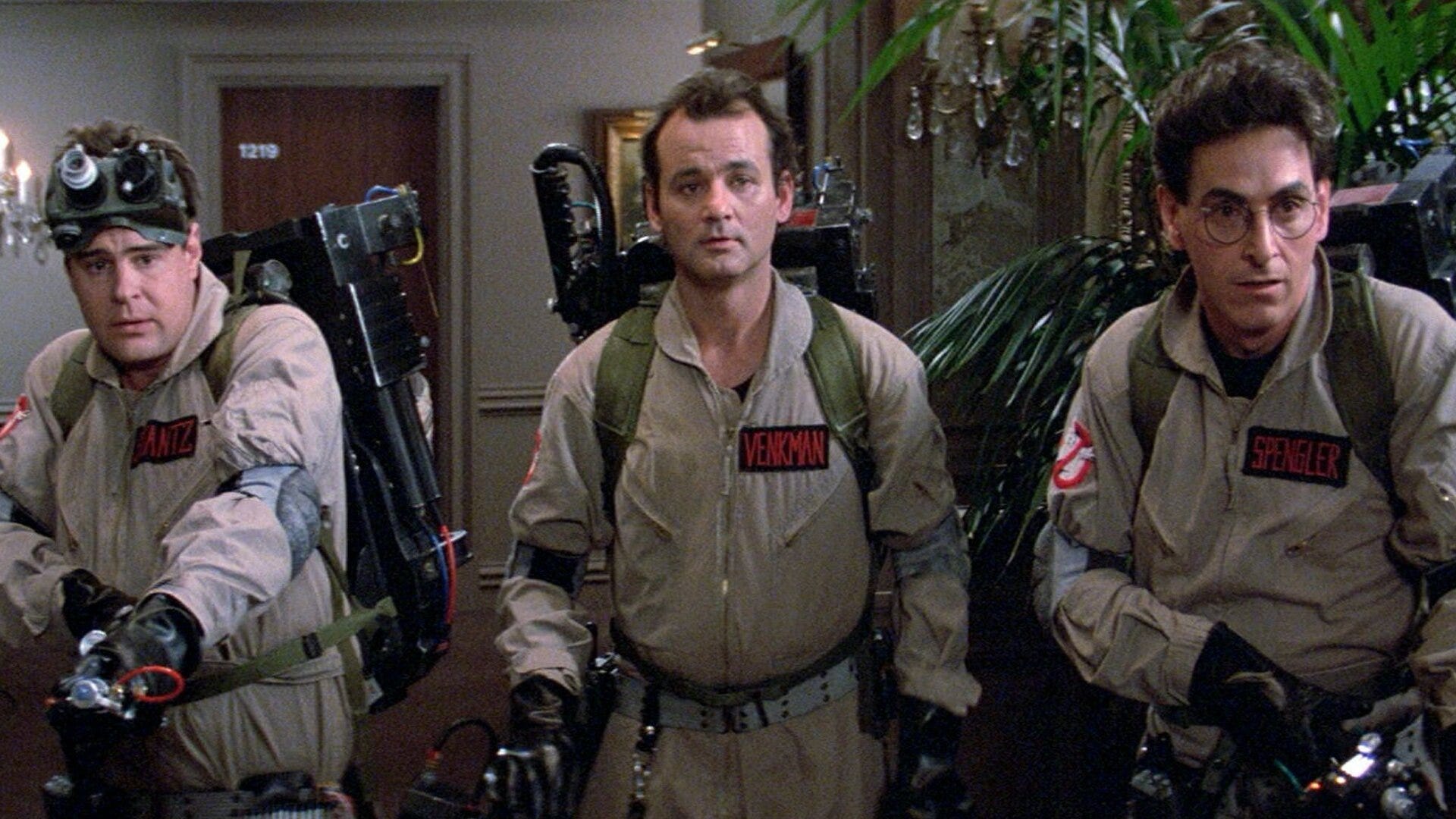
Dan Aykroyd and the Real Paranormal Experiences, Which Lead to the Ghostbusters.
Before the movie, Dan had his own Paranormal Experiences.
Dan Aykroyd was born on 1 July 1952 in Ottawa, Ontario, Canada. He emerged in the 1970s as one of the defining comic voices of North American television and film. An actor, writer, producer, and musician, he became known for a style that combined rapid intelligence, deadpan delivery, and a fondness for technical detail that often slipped into his characters.
He first gained national recognition as an original cast member of Saturday Night Live when it launched in 1975. Alongside performers such as John Belushi, he helped establish the programme’s early identity. His impressions and original characters, including the fast-talking salesman and the stern news anchor, displayed a precision that set him apart. During this period, he also formed a musical partnership with Belushi that evolved into The Blues Brothers, a rhythm-and-blues act that moved from sketch comedy to genuine chart success and touring.
Buy My Books. Paperback, Kindle and Kindle Unlimited:
In cinema, Aykroyd co-wrote and starred in The Blues Brothers and later co-wrote and starred in Ghostbusters, both of which became cultural landmarks of 1980s film. His filmography extends across comedy and drama, including roles in Trading Places, Driving Miss Daisy, and My Girl. In 1990, he received an Academy Award nomination for Best Supporting Actor for his performance in Driving Miss Daisy, marking recognition beyond comedic roles.
He was raised in a Catholic household in Ottawa. His father, Peter Hugh Aykroyd, worked as a civil engineer and policy adviser, while his mother, Lorraine Hélène Gougeon, was a secretary. Aykroyd attended St. Pius X and St. Patrick’s High School before studying criminology and sociology at Carleton University, although he did not complete his degree. As a young man, he worked in local clubs and developed an interest in blues music that would later influence his stage work.
Before his international success, he was active in the Toronto comedy scene. He became a member of the Second City troupe, which served as a training ground for several performers who would later join Saturday Night Live. His early career was marked by disciplined writing, an encyclopaedic memory for facts, and a willingness to immerse himself in niche subjects, qualities that later shaped both his comedy and his broader creative projects.
Paranormal Beginnings
In interviews given over several decades, Dan Aykroyd has stated that his interest in the paranormal began within his own family. His father, Peter Hugh Aykroyd, maintained a long-standing interest in nineteenth-century Spiritualism and psychical research. Family records indicate that Aykroyd’s great-grandfather participated in séances in Ontario during the late Victorian period, when table tipping and trance mediumship were common domestic practices in Canada and Britain.
Spiritualism had emerged in 1848 in Hydesville, New York, and by the 1870s, séance circles were widespread across North America. Participants met in private homes. Sittings commonly involved attempts at spirit communication through raps, automatic writing or controlled trance states. Within the Aykroyd family, these accounts were preserved as history rather than anecdote. Peter Aykroyd later drew on this research interest when he published A History of Ghosts, a historical survey of apparitions and documented hauntings.
Dan Aykroyd has said that books on mediums and psychic investigation were present in the house while he was growing up in Ottawa. He read material on documented cases and nineteenth-century investigations. He has described this exposure as early and matter-of-fact.
His first reported personal experience occurred in the early 1980s while living in California. In repeated radio and television interviews, he described hearing unexplained noises in his home and observing objects displaced from where he believed he had left them. He also recounted waking to the sensation of a presence lying down beside him in bed. He stated that he did not see a fully formed apparition but felt a physical impression and warmth. He described the encounter as calm and non-threatening.
He has repeated this account consistently. He has presented it as an event that confirmed ideas he had held since childhood, drawn from his family history of Spiritualist inquiry.
Ghostly Inspiration
In 1981, intrigued by what he regarded as genuine paranormal phenomena and drawing on decades of exposure to Spiritualist history, Dan Aykroyd began drafting a screenplay centred on academic parapsychologists. The protagonists were university researchers studying hauntings as measurable events rather than superstition. Their work focused on psychokinetic energy, spectral manifestation and the use of engineered devices to detect and contain anomalous forces.
The setting reflected real twentieth-century parapsychology programmes, in which controlled experiments were conducted under institutional oversight. In the script, once removed from the university, the researchers commercialised their work. Investigation became an enterprise. Equipment replaced séance tables. Containment units replaced spirit cabinets.
The narrative treated paranormal activity as a physical problem requiring instrumentation and applied theory. Energy could be tracked, stored and neutralised. Public fear was countered with apparatus and procedure. Although the film would ultimately be received as comedy, its foundation rested on structured investigation consistent with documented psychical research traditions dating back to the late nineteenth century.
After collaborating with Harold Ramis, the script was streamlined and set in contemporary New York. The core premise remained intact: trained researchers confronting measurable supernatural disturbances through technology rather than ritual.
If you still did not guess, the film was Ghostbusters.
A blockbuster Hit
Released in June 1984, Ghostbusters became one of the defining films of the decade. Produced on a budget of approximately 30 million US dollars, it went on to gross over 290 million US dollars worldwide during its initial theatrical run, placing it among the highest-grossing films of that year. In the United States, it dominated the summer box office for weeks, competing directly with major releases such as Indiana Jones and the Temple of Doom.
Critical reception was broadly positive. Reviewers noted the balance between technical effects and character-driven comedy. The film received two Academy Award nominations, for Best Original Song and Best Visual Effects. Ray Parker Jr.’s title track became a chart success in its own right, further embedding the film in popular culture.
For Dan Aykroyd, the success marked a transition from ensemble performer to architect of a global franchise. The film generated an animated series, merchandise, sequels, and sustained brand recognition that endured across decades. Its imagery, the converted firehouse headquarters, the proton packs, the containment grid, became internationally recognisable symbols.
What began as a screenplay influenced by structured paranormal investigation had entered mainstream culture on a large scale. The commercial triumph ensured that concepts drawn from psychical research, reframed through comedy and special effects, reached audiences far beyond specialist circles.
The franchise expanded into animation with The Real Ghostbusters and later Extreme Ghostbusters, both produced for television audiences. In 2016, the property was reimagined with an all-female lead cast in Ghostbusters, presented as a separate continuity. The original storyline returned decades later in Ghostbusters: Afterlife and continued with Ghostbusters: Frozen Empire, extending the narrative across a new generation.
More on Dan’s Paranormal Encounters
The most detailed account of his experience, as recounted by Dan Aykroyd, concerns the bedroom incident he has described on multiple radio programmes, including Coast to Coast AM. He stated that he had gone to bed and was awake when he felt the mattress depress beside him. He described the distinct sensation of weight, as though someone had sat down or lain next to him. He reported feeling warmth and the physical indentation in the bed. He said he believed at the time that it was a spirit presence rather than a person. According to his account, he rolled towards the impression, at which point the sensation ceased. He has emphasised that he was not frightened and that the presence felt benign. He has not claimed to have seen a face, figure or defined apparition during this event.
You can listen to this Coast to Coast AM episode here:
Aykroyd has also spoken about a residence in Los Angeles, often referred to in interviews as a house once owned by Mama Cass Elliot. He stated that while living there, he experienced what he regarded as minor but noticeable disturbances. In a radio interview, she described doors opening and closing without explanation and objects being moved. He did not report violent activity. He characterised the events as consistent with a haunting and again stated that he did not feel threatened.
In separate discussions about unidentified aerial phenomena, he has said that he witnessed unusual aerial lights. In one account, he described structured lights moving in a way he considered inconsistent with conventional aircraft behaviour. He has maintained that he did not interpret the sighting as a personal encounter but as evidence that unidentified craft warrant scientific investigation.
These are the principal experiences he has detailed in public interviews. He has not expanded them into elaborate narratives beyond what he has described in his own words.
After buying the LA house from Dan Aykroyd, Fred Willard described one incident that made a lasting impression. On a day when a heavy rainstorm was moving in, he returned home, took off his wet coat and set down his umbrella. He said he felt a sudden unease and glanced into the den. There, he saw a wooden rocking chair moving back and forth on its own. According to his account, the chair rocked steadily, then abruptly came to a dead stop. Willard said the sight gave him goosebumps. After that moment, he came to believe in ghosts.
The accounts given by Dan Aykroyd have remained consistent across decades. He has described a childhood shaped by documented family involvement in nineteenth century Spiritualism. He has recounted the bedroom incident in California in precise sensory terms. He has spoken of minor disturbances in homes he owned. He has maintained that he witnessed unusual aerial lights and that such phenomena deserve serious inquiry. He has not expanded these experiences into spectacle. He has repeated them without escalation.
Those experiences did not exist in isolation from his work. They informed us. The framework of organised investigation, the language of psychokinetic energy, and the treatment of hauntings as measurable events all reflect interests he has publicly acknowledged since youth. Without those real-world experiences and that inherited tradition of Spiritualist inquiry, the screenplay he drafted in 1981 would not have taken the form it did.
From private testimony to global franchise, the line remains traceable. The film that entered popular culture as comedy was rooted in a belief system and lived experiences its creator has never disowned.


That was a really good and informative read. Thanks for sharing!
I have also had experiences like feeling a presence on my bed. I have felt the mattress move under me while wide awake, and the impressions of someone or something moving around me on the bed.
It’s some really weird stuff! Just goes to show that the paranormal isnt anymore bothered by the famous.
Whoa