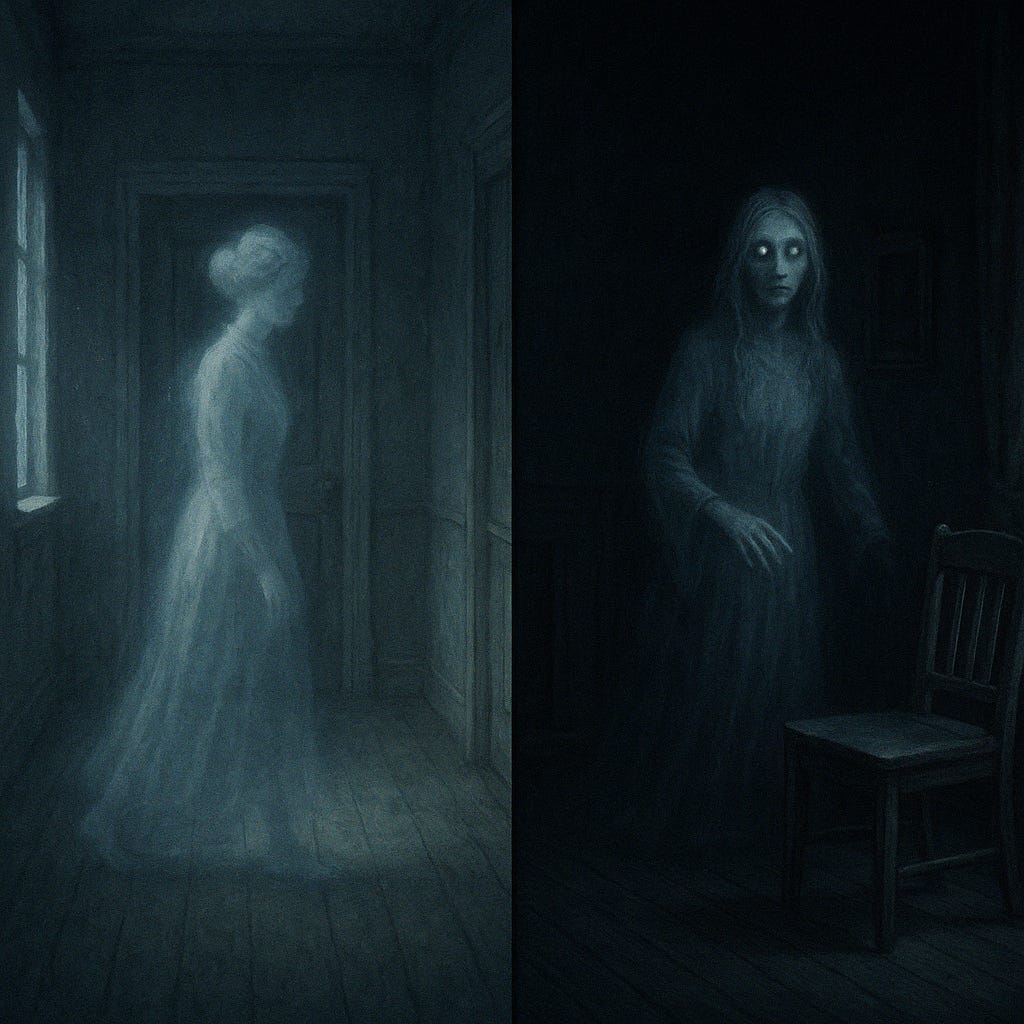
đ Paranormal Insights: Residual vs Intelligent Hauntings
Understanding the Two Fundamental Distinctions of Haunting
The term âhauntingâ carries weight. Most people imagine ghosts as conscious entities that are aware, interactive, and deliberately making their presence known. In paranormal research and documented accounts, however, hauntings divide into two fundamentally different phenomena, each with distinct characteristics, patterns, and implications for understanding what might actually occur in supposedly haunted locations.
The distinction between residual hauntings and intelligent hauntings provides a working framework for interpreting documented cases. It shapes not only how investigators approach their work but how families living in affected locations understand their experiences. Understanding these categories requires examining what they mean, how they manifest in practice, and what the historical record suggests about each form of paranormal activity.
*Both books also available on Kindle Unlimited
What is a residual haunting?
A residual haunting is understood as a kind of imprint or recording of past events, replaying with mechanical regularity independent of any current consciousness or intention. In this model, intense emotional or traumatic events leave a mark on a location itself, much like an echo trapped in physical space. The phenomena associated with residual hauntings typically manifest in predictable patterns: the same sounds at the same times, the same apparitions in the same locations, following the same routes.
The classic example involves footsteps heard in a corridor every night at the same hour, or a figure appearing in a doorway and walking the same path without acknowledgement of observers. These phenomena show no responsiveness to the present. They do not react to questions, do not deviate from their patterns, and do not seem to notice the living inhabitants of the space. They simply occur, with the regularity of a recording playing on a loop.
Residual activity is frequently associated with locations of significant trauma or emotional intensity. Battlefields where violence occurred, sites of accidents or sudden deaths, places where people experienced profound suffering: these locations frequently report residual phenomena. The intensity of the emotional experience, some researchers propose, somehow imprints itself onto the physical environment, creating a kind of psychic recording that continues to manifest long after the events themselves have concluded.
What makes residual hauntings particularly significant from a documentary perspective is their passivity. They represent no threat, make no demands, and require no interaction. A family living in a house with residual activity might hear the same phantom footsteps every evening at eight oâclock, witness the same shadowy figure descending stairs, yet experience no escalation, no communication, and no indication that anything conscious is present. The activity continues regardless of whether anyone is home to observe it or not.
The key identifying characteristics of residual activity include strict adherence to patterns, no response to external stimuli, consistency across time, and what could be described as a theatrical quality. The phenomena repeat their sequences without variation. Apparitions do not acknowledge observers. Sounds occur at identical times. The entire experience feels less like interaction and more like witnessing a moment from the past being replayed indefinitely.
Stone tape theory, a residual phenomena
The hypothesis most commonly invoked to explain residual haunting is known as Stone Tape Theory. The theory proposes that intense emotional or traumatic events can somehow be recorded into the physical fabric of a location, specifically into stone, brick, earth, and other materials, much as modern magnetic tape records sound or video. Just as a tape player can replay a recording indefinitely, the theory suggests that certain locations can replay the events imprinted upon them through some unknown mechanism involving energy, consciousness, or physical properties not yet understood by conventional science.
The theory takes its name from a 1972 BBC television play called âThe Stone Tape,â which explored the concept as science fiction. However, the underlying idea predates the play by decades. Paranormal researchers and investigators have long noted that hauntings seem to occur most frequently in locations associated with intense human experience: battlefields, sites of violent death, places of profound suffering. Stone Tape Theory attempts to explain why this pattern exists.
The mechanism proposed by Stone Tape Theory remains speculative. Some researchers suggest electromagnetic fields or some form of energy released during traumatic events imprints itself into the molecular structure of materials. Others propose that consciousness itself leaves an imprint, a kind of psychic recording that persists in physical space. Still others suggest unknown principles of quantum mechanics or physics yet to be discovered might account for the phenomenon. What unites these various approaches is the core idea: intense experience leaves a mark that can replay itself independently of any conscious entity.
Stone Tape Theory is particularly applicable to understanding residual phenomena because it explains several consistent characteristics observed in documented cases. Residual phenomena show mechanical repetition without variation because they are recordings replaying. They do not respond to observers or questions because a recording cannot perceive or interact with those observing it. They continue indefinitely because a recording does not degrade or stop unless the mechanism that sustains it is fundamentally altered or destroyed. They cluster in locations of intense trauma because traumatic events create the ârecordingâ through their emotional and energetic intensity.
Stone Tape Theory explains hauntings through a materialist framework: intense experiences imprint themselves into physical locations, which then replay those events mechanically. This eliminates the need to invoke consciousness persisting beyond death or traditional spirits. The mechanism remains unknown, but the theory accounts for residual phenomena without requiring anything supernatural.
what is an intelligent haunting?
An intelligent haunting, by contrast, suggests the presence of consciousness and intentionality. The phenomena associated with intelligent hauntings demonstrate responsiveness, adaptation, and what appears to be deliberate communication. These are hauntings in which something seems aware of the living occupants of a space and interacts with them in ways that suggest purpose and will.
Intelligent hauntings manifest in variable patterns rather than mechanical repetition. They respond to questions posed by investigators or residents. They move objects to specific locations with apparent meaning. They escalate or diminish in intensity based on the emotional state or behaviour of living people. They communicate through knocking patterns, through writing on surfaces, through moving objects in ways that convey specific messages. Some cases document apparitions that seem aware of observers, that react to their presence, that speak or attempt to communicate.
The defining characteristic is responsiveness. An intelligent haunting suggests that something present in the location is aware of the living inhabitants and is attempting some form of contact or expression. The activity adapts rather than merely repeating. It shows what could reasonably be interpreted as intention, emotion, and the desire to be acknowledged or understood.
Intelligent hauntings cluster around unresolved situations. Violent deaths that remain unexplained, buildings where people died with significant unfinished business, spaces connected to traumatic loss or injustice all attract intelligent activity. Whatever consciousness might persist appears to be attempting to communicate something about what happened, seeking resolution, or asserting presence in a location it remains emotionally connected to.
The practical difference
For those living in or investigating supposedly haunted locations, the distinction matters considerably. Residual activity, whilst disconcerting, typically presents no danger and no escalation. A family experiencing residual haunting learns to adapt to the patterns. The phantom footsteps at eight oâclock become background detail in the homeâs routine. The apparition in the hallway, whilst unsettling, follows a predictable path and poses no threat.
Intelligent hauntings, by contrast, often involve escalation and a degree of unpredictability that creates genuine distress. Activity intensifies during periods of emotional upheaval in the home. Objects disappear and reappear in unexpected locations. The phenomena become increasingly intrusive and demanding of attention. Residents frequently report feeling targeted or watched. The sense is less of coexisting with a recording and more of sharing space with something that has decided to make itself known.
Investigators approaching these distinctions treat them as frameworks for understanding what they encounter. A location showing consistent, unchanging patterns of activity at identical times suggests residual phenomena. A location where activity varies based on circumstances, where responses seem tailored to specific questions or situations, where escalation occurs during periods of emotional intensity, suggests intelligent phenomena. These are not absolute categories; many hauntings display characteristics of both. But they serve as useful lenses for interpreting what witnesses report and what investigators observe.
Intelligent Haunting: The Thayer Mansion, West Point Military Academy (1972)
The superintendentâs quarters at West Point, built in 1820 and known as Quarters 100, held an unusual distinction amongst military installations. Distinguished visitors passed through its rooms regularly. Government officials, Army leadership, and their wives stayed as guests of the commanding officer. Yet something in the house was systematically taking their belongings.
In October 1972, the commanding officer contacted Ed and Lorraine Warren. The situation had become untenable. Wallets disappeared from pockets. Money vanished from bedside tables. Personal mementos went missing from the rooms of eminent dignitaries. Hours or days later, every item reappeared, arranged neatly on the master bedroom dresser as though deliberately staged. Military police had investigated. No person was stealing these objects. The officer, speaking to the Warrens before their scheduled lecture that evening, put the question directly. Could a ghost manipulate physical objects?
Lorraine Warren walked the house methodically, room by room, seeking psychic impressions. In the MacArthur bedroom, where President Kennedy had stayed during his visits to the Academy, she felt only the residual vibrations of the powerful figures who had passed through. She perceived no mischievous presence, yet suspected the spirit might be deliberately avoiding detection.
That evening, after the lecture, Lorraine entered a trance in the MacArthur bedroom. Officers and their wives watched. Sorrow came through.
âI see a black man approaching,â she said, speaking as though narrating events unfolding before her. âHeâs wearing a dark uniform with no braid or decoration. This man is with us now. He is overtaken with a sense of fear, guilt, and lack of acceptance. He feels very sorry for something.â
The man identified himself as âGreerâ. According to his own account through Lorraineâs communication, he had been accused of murder. His cell, he said, was in the basement. Yet the Army had exonerated him of that crime. He did not know. His records had been lost, scattered, impossible to trace. The official clearing of his name meant nothing if Greer himself had never learned of it. That silence had become unbearable.
When Lorraine asked why he was taking the wallets and valuables, his answer was clear. He wanted the Army to know his sorrow. Each stolen item was communication. Each careful placement on the dresser was a message from a man whose honour had been destroyed, regardless of what his official records said.
Lorraine, speaking with measured authority, told him: âThe Army has since exonerated you of that murder. Your exoneration stands. Your sorrow is understood by the Army. But it is only proper that your sorrow be over. There is nothing we can do for you. You are holding yourself back; you must exonerate yourself.â
She guided him toward the light. âIt is time for you to surrender yourself and begin again. Go to your friends and family. Go home to the light, Mr. Greer.â He vanished from her perception.
Weeks later, whilst lecturing at Boston University, Ed and Lorraine received a telephone call from West Point. The Army had conducted a thorough search of its records. They had found documentation of a Black porter named Greer, assigned to the Thayer Mansion in the early nineteenth century. He had been accused of murder. The Army had exonerated him. His records had been in disorder. Scattered, incomplete, difficult to trace. He would now be filed as deceased.
The phenomena at Quarters 100 ceased.
What distinguished Greerâs haunting from mere residual repetition was consciousness itself. A residual haunting loops mechanically. The same footsteps, the same sounds, the same actions replay regardless of circumstance or audience. Greerâs activities showed awareness. He selected items from specific people of rank and importance. He staged them deliberately on the dresser. He responded to communication. When told directly that his exoneration stood and that his sorrow was understood, he released himself and departed.
For over a century, Greer had carried an impossible burden. The knowledge that he was innocent, yet the uncertainty of whether anyone else knew it. The Armyâs official exoneration meant nothing if the man himself did not know he was cleared. Intelligence, guilt, and the desperate human need for recognition were what kept him present, not the mechanical imprinting of trauma that defines residual phenomena.
His case illustrates a truth that investigation reveals consistently. Intelligent hauntings arise from unresolved emotional states, from questions that demand answers, from the persistence of consciousness itself in the face of profound injustice or incomprehension. A ghost that steals wallets and arranges them carefully is speaking. It is communicating intention, not repeating a moment of death.
Intelligent Haunting: Epworth Rectory
The Epworth Rectory haunting represents one of the most thoroughly documented cases of apparent intelligent paranormal activity in English history. The rectory was home to Reverend Samuel Wesley, his wife Susanna, and their family in Lincolnshire. One of their children was John Wesley, who would later found the Methodist movement. The haunting occurred between December 1716 and January 1717 and was extensively documented through family correspondence and eyewitness accounts written by multiple family members and servants.
The disturbances began on December 1, 1716, when the servant Robert Brown and a housemaid heard groaning sounds in the dining room. Groans that seemed to come from someone in extreme distress or dying. The sounds were so convincing that at first the servants believed a dying man must be outside the house. Within days, the knocking began. The entire household, with the notable exception of Reverend Wesley himself, heard distinct rapping sounds, typically in patterns of three or four knocks. The sounds moved throughout the house, occurring in different locations on different nights. A distinctive pattern emerged. Approximately fifteen minutes before nine forty-five each evening, observers heard sounds like a jack winding up or a saw creaking. A kind of preliminary wind-up before the eveningâs activity began in earnest.
What distinguished the Epworth phenomena from typical residual activity was its responsiveness. When family members knocked back in response, the entity would return the same knocking pattern. More remarkably, the poltergeist demonstrated apparent awareness of the living inhabitants and their actions. It seemed to know who was present, who was seeking it, and how to manipulate their expectations and emotions. Reverend Wesley, who initially dismissed the disturbances as fabrication by his children or servants, eventually confronted the entity directly. According to John Wesleyâs own account, his father said sternly: âThou deaf and dumb devil, why dost thou frighten these children that cannot answer for themselves? Come to me to my study that am a man!â
Instantly, the poltergeist knocked Reverend Wesleyâs distinctive knock. The precise knock he always used at the gate. So forcefully that the board seemed about to shatter. The specificity of this response is critical. The entity knocked the particular pattern that Reverend Wesley habitually used. After that night, no disturbance occurred in his study. But the next evening, when the Reverend attempted to enter his study to do his evening work, the door was thrust back violently, nearly knocking him down. The entity had acknowledged his challenge, responded to it by mimicking his personal signature knock, and then prevented him from entering his private space. This is tactical response.
Robert Brown, the familyâs servant, pursued the knocking sounds on multiple occasions. He described following them from room to room as they moved throughout the house. He witnessed a hand mill moving at great speed of its own accord. He heard the sound of heavy boots walking through the corridors and the sound of furniture being overturned, yet when he investigated, found nothing displaced. The phenomena seemed to deliberately elude direct observation while remaining audible and persistent.
The poltergeist was particularly active during family prayers. When the Wesleys gathered to pray, the knocking became furious and insistent, as though the entity was deliberately disrupting their religious activities. This targeting of prayer times suggests awareness of the familyâs practices and deliberate opposition to them. The family nicknamed the phenomenon âOld Jeffrey,â possibly after someone who had died in the previous building on that site.
Mrs. Susanna Wesley, frustrated by the disturbances, called for a horn to be sounded throughout the house to frighten away what she believed might be rats. After that, the activity increased rather than decreased, and phenomena began occurring during daylight hours as well as at night. This escalation following Mrs. Wesleyâs attempt to dismiss or drive away the entity suggests that the poltergeist took offence at this action and responded by intensifying its manifestations. A passive, residual imprint would not respond to having a horn sounded at it; an aware entity might well perceive this as a hostile act and respond accordingly.
The activity continued for approximately two months with varying intensity. Different family members reported different experiences at different times, yet the overall pattern showed consistency combined with apparent adaptation to circumstances. Most significantly, the phenomena appeared to follow family members from room to room and, according to multiple accounts, demonstrated selective targeting. Some family members experienced more intense manifestations than others. Daughter Hetty, in particular, seemed to attract the entityâs attention and became a focus of phenomena.
The intelligence displayed by the Epworth entity went far beyond simple mechanical repetition. It showed apparent emotion, targeted awareness of individuals, and the ability to modify its behaviour in response to external stimulus. When threatened, it escalated. When prayers occurred, it disrupted them. When confronted, it rose to meet the challenge and demonstrated knowledge of personal details it should not have possessed. This is not the behaviour of a residual imprint replaying traumatic events in mechanical fashion. This is the behaviour of something conscious, aware, emotionally reactive, and intentionally interactive.
Residual Haunting: Gettysburg Battlefield
In stark contrast to the intelligent interaction documented at Epworth Rectory, or West point Academy, the Gettysburg Battlefield demonstrates the characteristics of pure residual haunting. The Battle of Gettysburg, fought over three days in July 1863, resulted in approximately 50,000 casualties. Bodies lay scattered across fields and streets. The intensity of trauma, death, and violence created what many researchers consider an ideal condition for residual imprinting.
The paranormal phenomena reported at Gettysburg show consistent patterns of mechanical repetition. Visitors and staff report hearing phantom sounds: disembodied voices, marching footsteps, cannon blasts, and the distinctive sound of rifle fire. These sounds occur in particular locations with remarkable consistency. The same areas produce the same phenomena. Iversonâs Pits, where over 900 soldiers died in just minutes, consistently produces reports of soldiersâ voices and the sounds of warfare. Triangular Field, site of extraordinary carnage, repeatedly produces cannon blasts and screaming sounds that have no apparent source.
Critically, these phenomena show no responsiveness to observers. The sounds continue regardless of whether anyone is present to hear them. They do not change based on questions posed by investigators. They do not escalate in response to emotional engagement or confrontation. They simply occur, night after night, in the same locations, at sometimes similar times, manifesting the same auditory phenomena repeatedly.
Apparitions reported at Gettysburg share this mechanical quality. Visitors describe seeing soldiers in Civil War uniforms walking along the same routes, appearing and vanishing at predictable points. The spectral Confederate sentry reported to pace back and forth in the cupola of Pennsylvania Hall does not acknowledge observers. It does not interact with visitors. It simply repeats its patrol endlessly.
One particularly striking account involves visitors seeing phantom soldiers moving through specific areas of the battlefield. These apparitions do not deviate from their paths. They do not respond to questions. They do not acknowledge the living people around them. They appear, they move along an established route, and they disappear. The pattern repeats with haunting consistency.
The sounds most frequently reported at Gettysburg are phantom cannon fire, distant screaming, the sounds of wounded men moaning. They create an unsettling sensory environment. These sounds do not change based on investigation attempts. They do not answer questions. They do not escalate in response to provocation. They manifest according to their own schedule, indifferent to the presence of the living.
The intensity of trauma at Gettysburg seems to have created a residual imprint so powerful that it manifests consistently across more than 150 years. The emotional and physical violence of those three days appears to have left a permanent scar on the location itself. What witnesses encounter there is not intelligence attempting communication. It is the echoing of past trauma, the psychic imprint of death replayed endlessly through the fabric of the place where it occurred.
Residual Haunting: Lady Blanche de Warenne - Rochester Castle (1264)
The siege of Rochester Castle in 1264 lasted only days. Simon de Montfortâs rebel forces pounded the walls with mangonels, catapult machines that hurled massive stones. Teams of men pulled ropes to swing wooden arms, launching projectiles that shattered stone and mortar. Miners began tunnelling beneath the keep. King Henry III was approaching with his army, and when news reached de Montfort, he ordered a retreat. The defenders, emboldened by the kingâs proximity, pursued the fleeing rebels.
The story goes that Lady Blanche de Warenne watched from the southern battlements. Her betrothed, Sir Ralph de Capo, rode with the pursuing defenders. She saw a knight in identical surcoat to Ralphâs galloping back towards the castle gates. He rode unchallenged into the keep and climbed to the ramparts where he seized her.
The knight was Gilbert de Clare, rejected suitor of Lady Blanche. He had donned Sir Ralphâs surcoat to gain entry.
Sir Ralph, looking up from the fighting, saw his lover struggling against assault. He seized an archerâs bow, took aim, and fired an arrow high into the air. It glanced off de Clareâs armour. The arrow pierced Lady Blancheâs breast instead.
She fell from the battlements.
That night her ghost was seen walking upon the battlements. The arrow still protruded from her body. Dark hair streamed in the breeze, vivid contrast to the brilliant white of her dress. She has walked her timeworn path ever since.
What we do know with certainty is, what happened after. For centuries, witnesses at Rochester Castle have reported a solitary figure in white on the southern battlements. The apparition walks the same route. She moves with the arrow still embedded in her. The sightings follow no pattern tied to observers or investigation attempts. The ghost appears, retraces her steps, and vanishes. The exact conditions of her death replay in isolation from the living world.
Blancheâs haunting shows no awareness. She does not answer questions. She does not respond to provocation. She does not acknowledge the presence of the living. She manifests the moment of her death repeatedly, mechanically, as though trapped in a single frame of time. The arrow remains. She walks her path in silence, repeating it across centuries, indifferent to who watches.
This is the signature of residual haunting. The trauma of death imprints itself upon the location. The consciousness is absent. What remains is the echo, the recording, the moment endlessly replayed without awareness or intention. Lady Blanche does not haunt Rochester Castle. Her death haunts it.
Understanding the Distinction Through Investigation
The contrast between intelligent and residual hauntings emerges clearly across documented cases. At Epworth Rectory, the entity responds to Reverend Wesleyâs challenges, mimics his personal knock pattern, and prevents him from entering his study. At Gettysburg Battlefield, phantom cannon fire and distant screaming repeat mechanically without variation, respond to nothing, and show no consciousness. Lawrence Greer at West Point deliberately took valuables from distinguished visitors and arranged them on a dresser, communicating his sorrow through intentional action. Lady Blanche de Warenne at Rochester Castle walks the battlements endlessly with the arrow protruding from her body, repeating the moment of her death without awareness or variation. Greer shows consciousness and purpose. Blanche shows none. One haunting is a dialogue. The other is a recording.
Investigators employ specific methodologies to distinguish between these two types of activity. When investigating suspected residual phenomena, researchers focus on establishing tight patterns. They document when phenomena occur, what forms they take, and whether these elements remain consistent across multiple observations. They attempt to correlate the phenomena with historical events, seeking connections between the repetitive activity and documented trauma or significant deaths.
When investigating intelligent hauntings, researchers employ different techniques. They attempt direct communication through questions and challenges. They document how phenomena change based on investigator actions and emotional engagement. They look for evidence of apparent knowledge or consciousness in the entityâs responses. They examine whether activity escalates when challenged, whether questions receive coherent answers, and whether the entity demonstrates apparent emotion or reaction to being confronted.
Environmental monitoring also distinguishes the two forms. Residual activity typically shows no correlation with temperature changes, electromagnetic fluctuations, or other measurable variables beyond what occurs naturally. Intelligent hauntings frequently correlate with measurable environmental changes. Temperature drops often occur when intelligent entities manifest. Electromagnetic fields may spike around apparitions. These measurable changes suggest active consciousness directing the phenomena rather than passive environmental imprinting.
In residual cases, investigators expect to find that phenomena cease completely when conditions change, when buildings are demolished, when the locationâs purpose changes. In intelligent cases, phenomena often persist across these changes or adapt to them, suggesting conscious continuity rather than mechanical imprinting.
Understanding the Distinction Through Investigation
The fundamental questions underlying the residual versus intelligent distinction concern the nature of consciousness and what might persist beyond physical death. A residual haunting suggests that traumatic moments can leave permanent impressions on physical space, that energy or emotion can imprint itself into the environment in ways current science has not explained. It does not necessarily require consciousness to persist; it requires only that intense experiences leave a kind of scar in the fabric of a location.
An intelligent haunting suggests something more profound. Consciousness itself might persist beyond the death of the physical body. Awareness and will might continue to exist. Communication across the barrier between life and death remains possible. What is understood as death might be a transition rather than an ending.
The documented cases examined here show what hauntings reveal. They demonstrate discernible patterns. The patterns differ significantly depending on whether the activity appears conscious and purposeful or mechanical and repetitive.
For families living in affected locations, the distinction matters immediately. Residual activity requires adaptation but not intervention. Intelligent activity might require communication, negotiation, or assistance in resolving whatever has attached the conscious entity to the location. Understanding which form of haunting a family faces shapes how they respond to their experiences.
For investigators, the distinction provides tools for systematic evaluation of phenomena. It offers frameworks for understanding what they encounter and methodologies for gathering evidence that distinguishes one form from another. It transforms haunting investigation from pure speculation into systematic observation and analysis.
For those interested in the paranormal more broadly, the distinction raises the deeper question: what do these two fundamentally different forms of activity suggest about the nature of human consciousness, the possibility of persistence beyond physical death, and the relationship between traumatic events and the physical spaces where they occur?
The unknowable question
What remains genuinely unknowable is the deeper question underlying all of this. Why do some spirits remain engaged with the living world, responsive and aware? Why do others become mere echoes, replaying the same moments over and over without consciousness or will?
What separates the spirit that responds, that attempts communication, that shows every sign of persistent intention from the imprint that simply repeats? Is it unfinished business that keeps some spirits present and aware? Is it the nature of their death, or something intrinsic to their nature as they lived? Does the consciousness of an entity at the moment of death determine whether it remains trapped in residual repetition or capable of intelligent interaction?
Or does the distinction itself rest on assumptions for which there is no real justification? Perhaps both forms of haunting operate under principles entirely foreign to current understanding. Perhaps neither explanation offered by paranormal theory comes close to the actual mechanism at work.
The documented cases show that intelligent and residual hauntings exist as measurable phenomena. They follow patterns. They recur across locations and centuries. Whether these cases answer the question of what consciousness is, or what persists after death, remains genuinely open. What they do establish is that the question itself arises from verifiable experience, not speculation.
For now, the distinction between residual and intelligent hauntings remains a useful tool for understanding documented phenomena. It provides language for discussing what witnesses report. It offers investigators methodology for systematic analysis. It helps families understand what they are experiencing and how they might respond. But it leaves the deeper mystery untouched. That mystery remains as profound now as it has ever been.
Investigation and Implications
Residual investigations document consistent patterns. Phantom footsteps at eight oâclock precisely. Apparitions in the same doorway. Sounds lasting identical durations across multiple observation sessions. Consistency suggests imprinting rather than consciousness.
Intelligent phenomena investigations look for escalation. Intelligent entities intensify activity when challenged. Residual phenomena continue unchanged regardless of investigation. An investigator confronting intelligent activity may provoke dramatic escalation. Objects thrown more violently. Sounds becoming louder. Apparitions appearing more frequently.
Residual phenomena replay the same moment eternally. The phantom soldier appears at dawn, walks the same route, disappears at dusk, repeats unchanged. Temporal imprisonment. Intelligent phenomena exist in the present. They respond to current circumstances and adapt. The Epworth poltergeist escalated when confronted. It responded in real time.
In residual cases, emotion appears captured at one moment and replayed forever. In intelligent cases, emotion develops. The entity becomes angry when confronted, frustrated when ignored, satisfied when achieving something.
Intelligent phenomena sometimes resolve. When an entity achieves communication, the phenomena cease. Residual phenomena continue indefinitely, never resolving.
Residual phenomena suggest consciousness or energy connects to the physical world. Intelligent phenomena suggest consciousness persists beyond death. Death becomes a transition, not an ending.
The distinction suggests that haunting encompasses two fundamentally different situations. One is a psychic recording. The other is continued consciousness after death.
For families, the distinction provides practical guidance. Residual activity requires adaptation. Intelligent activity requires communication and negotiation. Understanding which situation one faces enables appropriate response.
These cases raise questions that remain unanswered. What creates residual imprints? What determines whether consciousness persists after death? We may never know.


