Sir Noface: The Apparition of Cockatoo Island
The 45 Seconds That Changed Everything
Sydney Harbour, NSW. February 2014.
Paranormal investigator night vision cameras inside the Officers’ Quarters of Cockatoo Island captured forty-five seconds of footage. A child-sized figure peers around a doorframe in the hallway, looks toward the camera, then retreats behind the door and out of sight. While you might feel this footage may be inconsequential, it sent shockwaves around paranormal communities globally.
Full-body apparitions on film are extraordinarily rare. Most captured footage is later debunked. This figure withstood every test applied to it. The visual effects analysis found no digital manipulation. The team were questioned vigorously, but accounts remained consistent under scrutiny. Nothing could explain what the cameras recorded. It was as rare as photographing a unicorn.
The footage would lead to a two-year paranormal investigation. Chad Calek would later claim it as the most significant evidence of ghosts ever captured on camera. It would remain unresolved, neither authenticated nor debunked.
How to support my work:
Buy My Books. Paperback, Kindle and Kindle Unlimited:
Cockatoo Island
Cockatoo Island sits in Sydney Harbour at the junction where the Parramatta River and Lane Cove River meet. It is approximately three kilometres from Circular Quay. The island is 17.9 hectares, expanded from its original 12.9 hectares through decades of quarrying and excavation. The indigenous peoples of Sydney knew it as Wareamah. The Wallumedegal, Wangal, Cammeraygal, and Gadigal peoples used the island as a fishing base and meeting place for thousands of years before European settlement. The landscape itself holds connection to traditional waterways and country.
A Dark History
In 1839, Governor Sir George Gipps proclaimed the island a penal establishment. Sixty convicts arrived from Norfolk Island on 21 February 1839. They were housed in tents on an island without fresh water and filled with snakes. Many were repeat offenders, men deemed too dangerous for the mainland colonies. Over thirty years, these prisoners would carry out back breaking labour. They would quarry stone, build structures, dig a dry dock, and carve silos from solid rock. By 1842, 140 tonnes of grain sat in twenty underground silos. Each silo averaged 5.7 metres deep and six metres wide, hand-excavated by convict labour. The Fitzroy Dock, begun in 1847, required the excavation of 1.5 million cubic feet of rock. The work was brutal. The conditions were horrendous. Superintendent Charles Ormsby employed leg irons, solitary confinement, and the cat-of-nine-tails. He also diverted convicts to his personal garden, selling 40,000 cabbages per year.
By 1860, the convicts refused to work. They went on strike over the administration of sentence remissions. The ringleaders were marched off to Darlinghurst Gaol in a procession described by the Sydney Morning Herald as a gathering of “villainous looking ruffians.” By 1869, Cockatoo Island closed as a penal establishment. The remaining prisoners were transferred elsewhere. The island attempted a name change to Biloela, hoping to wash away its reputation.
In 1871, the barracks became an industrial school for girls and a reformatory for young women. Disobedient girls faced punishment in the same underground cells that had held hardened criminals. That same year, the training ship Vernon was moored offshore. Delinquent and orphaned boys lived aboard the vessel, confined to the island and its waters. Boys arrived from across New South Wales. Many were homeless. Many were unwanted. They remained on the Vernon until 1911, decades of vulnerable children passing through the island’s institutional system.
From 1857 onwards, the island transformed into a shipbuilding facility. The Fitzroy Dock anchored this transition. In 1890, the Sutherland Dock opened, capable of servicing 20,000-tonne vessels. In 1913, the Commonwealth Government purchased the island. It became the official Naval Dockyard, the heart of Australian naval construction through both World Wars. During the Second World War, it served as the primary ship repair facility in the Southwest Pacific. HMAS Arunta, HMAS Warramunga, HMAS Bataan, and countless other vessels were constructed or repaired there. The last ship, HMAS Success, launched in 1984. By 1991, the dockyard closed.
In 2001, the Sydney Harbour Federation Trust assumed control. The island transformed from industrial site to heritage attraction. In 2010, it received UNESCO World Heritage status, recognised as the largest surviving complex of convict-built structures in Australia. Today it hosts cultural events, art installations, camping facilities, and guided tours. Visitors walk the same sandstone plateau where convicts quarried. They pass through barracks where 500 men were confined. They see underground cells where children were punished. The island’s architecture carries the weight of centuries of suffering compressed into stone.
The Investigation Begins
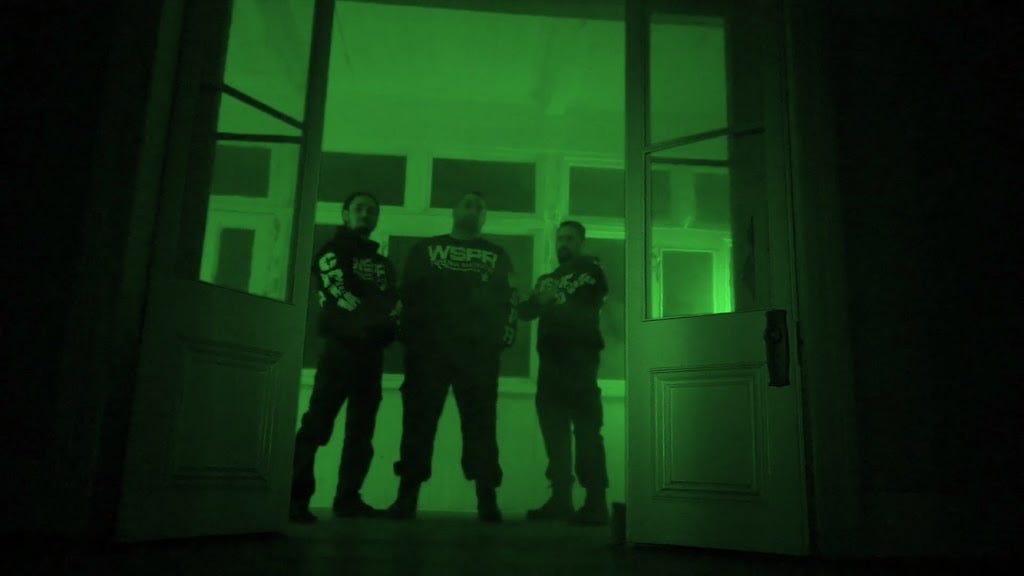
Craig Powell founded the West Sydney Paranormal Research Team around 2010. The group was small, operating as a two-person operation with Powell and his wife Nicky Myers. WSPR established a website in 2010 and documented investigations across Sydney and regional New South Wales. In February 2013, something shifted. According to later accounts, the Australian Government contacted Powell directly. Over 500 reports of paranormal activity had been made at Cockatoo Island by visitors and staff. The government wanted to determine whether the claims were legitimate. They were interested in developing the site for heritage tourism. They authorised Powell to conduct a comprehensive paranormal investigation with unlimited access to the island.
The investigation lasted twenty-two months, from February 2013 through late 2014. Powell and his team spent significant time on the island, conducting overnight investigations and setting up surveillance equipment. They documented motion detectors triggering in empty hallways. They recorded unexplained bright flashes of light with no apparent source. They heard disembodied voices. Powell reported having his shirt tugged by an unseen force.
The team concentrated on the Officers’ Quarters, a structure dating from the 1840s that housed military officers during the convict era. It later served administrative functions. The building sits on the highest part of the island’s plateau, overlooking Sydney Harbour. It is isolated. It is often unoccupied. It carries 170 years of institutional weight.
The Night of 15 February 2014
Powell set up static surveillance cameras in the Officers’ Quarters. Nicky Myers was present to assist with the setup. The cameras were positioned as part of systematic documentation. They were not set up to capture any specific phenomenon. Powell and Myers left the equipment running and departed.
The footage captured forty-five seconds. A hallway in the Officers’ Quarters, dimly lit by infrared illumination. A stationary camera mounted at a fixed point. For several seconds, nothing moves. Then, at the far end of the hallway, partially obscured by a doorframe, a figure of a child emerges. Its height is approximately 137 centimetres. The figure leans out from behind the doorframe as if looking directly at the camera. Then it retreats back into darkness. The visible facial area of the figure is blank, and this is why it gained the name Sir Noface.
What the Team Believed
Powell and his team came to believe they had established a relationship with the entity called Sir. They claimed that over time, the entity became responsive to their requests. When they asked Sir to generate light, the entity would produce flashes of illumination lighting the entire hallway with uniform intensity and no shadows. This occurred repeatedly, on command, during investigations.
The team speculated that Sir was the spirit of a child who died on the island. The small stature suggested a young victim. Girls between ages eight and eighteen were housed in the reformatory between 1871 and 1888. Boys, many of them delinquent, orphaned, or homeless, were trained aboard the school ships. The island’s history of childhood trauma provided context for the entity’s presence.
The responsiveness of the entity was significant. Powell believed Sir was not a residual haunting, a repeated playback of a traumatic event. He believed it was an intelligent haunting, a conscious entity capable of intention and interaction.
Chad Calek Arrives
Chad Calek is a filmmaker and paranormal investigator known for work on A&E’s Paranormal State and the documentary American Ghost Hunter. He toured Australia in 2014 and met Craig Powell at a paranormal investigation conference. They developed a professional acquaintance. Powell and the team at WSPR, were due to give a presentation of their investigations, methods and evidence. This is where Calek first saw the Sir Noface footage.
Here is a clip of audience’s reaction on seeing the clip of Sir Noface for the first time.
Calek described being “floored” by what he saw. He stated it was the most definitive evidence he had encountered in twenty-five years of paranormal investigation. But he also recognised the magnitude of the claim. He approached Powell with a proposition. He would make a documentary, but he would apply rigorous scrutiny to both the footage and the team. Powell agreed, saying he had nothing to hide.
Calek’s Investigation
Calek interviewed Craig Powell, Nicky Myers, and other WSPR team members. He asked probing questions about their motivations, their backgrounds, and whether they might have fabricated evidence for attention or financial gain. He investigated their histories and professional standing. He was deliberately antagonistic, pushing for inconsistencies.
Myers stated that what occurred on the island was “150% real. Without a doubt.” Powell maintained his account of the investigation. The team came across as genuine to Calek. They demonstrated knowledge of paranormal investigation methodology and maintained consistent narratives across multiple interviews. While they had potential motivations to fabricate evidence, Calek found them respectable and genuine.
Calek turned to Danny Patterson, a senior animator from major Hollywood productions including Transformers, The Marvle Cimnematic Universe, Pirates if the Caribbean, Lord of the Rings, and many more. Patterson examined the footage with professional scrutiny. He analysed whether the figure could have been created using digital manipulation or conventional CGI.
Patterson’s conclusion was that the footage did not display hallmarks of digital manipulation. The figure was not created using conventional CGI techniques. However, Patterson noted the movement was unusual and not quite human. If fabricated, it would have required someone with decades of professional experience and sophisticated equipment.
Patterson attempted to recreate the footage using CGI. He produced a digitally generated version. When comparing the original and the recreation, significant differences were apparent. The original figure’s movement and physicality were distinct from Patterson’s creation.
Patterson concluded by stating: “There is no way for me to tell you that this is fake.” This was deliberately cautious language. It was not confirmation of authenticity. It was acknowledgment that he could not definitively prove the footage was fabricated.
Calek interpreted this conclusion more definitively. In the documentary, he stated that “Danny absolutely concluded it is not CGI.” This went beyond what Patterson actually said. Patterson had said he could not prove it was fake. Calek presented this as proof it was real.
Height and Identity
Calek compared the Sir Noface figure to the proportions of the Officers’ Quarters hallway and doorframe. He conducted measurements and reconstructions to determine the entity’s approximate height. He calculated Sir Noface stood approximately 137 centimetres, about four and a half feet tall.
This height ruled out an adult security guard or any WSPR team member. Powell said none of his children were present on the island that night. It was only his team and a single secutiry guard. At the time, the team were on another part of the island. The height corresponded to a child. This renewed speculation about the island’s history of childhood suffering. Between 1871 and 1888, girls were housed in the reformatory. Between 1871 and 1911, boys were trained aboard school ships. The apparition might be the spirit of one of these children, a young victim whose trauma anchored itself to the location.
Calek’s Conclusion
After his investigation, Calek reached a definitive conclusion. He stated: “This figure, this being, this entity is a ghost. Make no mistake about it. That is what you are looking at.”
Calek presented the footage and his analysis as proof of ghosts. When all other possibilities were exhausted, only one conclusion remained. Sir Noface was a genuine apparition of a deceased individual, likely a child who died on Cockatoo Island during the institution’s darker periods.
Calek announced he was ending his involvement in paranormal investigation. The case had convinced him that the reality of ghosts was demonstrated beyond reasonable doubt.
Cockatoo Island Today
Cockatoo Island remains a UNESCO World Heritage Site and public heritage attraction. The Sydney Harbour Federation Trust manages it as a landmark heritage destination with cultural events and accommodation. The island hosts the Biennale of Sydney, music festivals, theatre productions, and camping facilities. Visitors tour convict-era buildings, shipyard structures, and docks. They walk through barracks where 500 men were confined. They pass underground punishment cells. They walk the plateau where convicts quarried stone.
The Officers’ Quarters remains accessible to the public as part of heritage tours. No official signage marks it as a paranormal hotspot. The Trust makes no reference to the Calek investigation or Sir Noface.
Hundreds of visitors occupy the island each year. No recent accounts of widespread paranormal activity consistent with the WSPR investigation have emerged. The island functions as a heritage site and recreational destination.
The Documentary
The trailer:
In 2018, Calek released the documentary Sir Noface. The film runs one hour and forty-four minutes. According to reviews and viewer accounts, most of the runtime is devoted to Calek’s biographical background, his previous investigations, his family life, and abstract tangents loosely connected to the case. The actual footage of Sir Noface comprises approximately two minutes of the total runtime.
Calek mounted a theatrical tour called “Sir Noface Lives,” presenting the documentary in various cities with question-and-answer sessions and meet-and-greets.
Critical reception has been mixed to negative. Reviewers criticised Calek’s self-aggrandising narrative style and excessive focus on his own background. Several noted the Sir Noface footage occupies minimal screen time. Others questioned whether the investigation was rigorous enough to support his definitive conclusions.
Audience response varied. Paranormal enthusiasts were sometimes convinced by the evidence. Sceptics found the investigation superficial and the conclusions premature. Many expressed frustration that no independent verification existed and that exclusive rights prevented wider scrutiny.
Watch the full documentry here:
The Case Today
The case remains contested. The footage has not been definitively authenticated or debunked. No official government acknowledgment of the paranormal investigation exists. The WSPR team did not pursue independent verification. Calek’s documentary remains the primary vehicle through which the Sir Noface case is known to the public.
The entity itself remains unresolved. Whether it is a genuine apparition, an elaborate hoax, or something else entirely is unknown. Sir Noface, the faceless figure of 137 centimetres in height, exists in forty-five seconds of footage captured in the Officers’ Quarters on 15 February 2014. What that footage represents remains open.
Cockatoo Island continues as a heritage site. The paranormal investigation that consumed twenty-two months of WSPR’s work has left no mark on the island’s official historical narrative. The supposed relationship between investigators and the entity called Sir remains documented only in Calek’s documentary and Powell’s interviews. No independent corroboration exists.
The case stands as an unresolved document of a paranormal investigation. Rigorous in some respects. Incomplete in others. Preserved through a filmmaker’s interpretation of events that occurred in the shadows of an island bearing centuries of human suffering and institutional trauma.
What are your thoughts on this casefile? Please get the conversations going in the comments. 💬


Brilliant breakdown of the Patterson analysis paradox. The "cant prove its fake" framing really gets at how we've inverted the burden of proof in paranormal cases. I ran into the same logic trap when I was analyzing supposedly anomalous radar data - absense of disproof became proof to belivers. What makes this case intresting though is how tightly the investigators control acces to the original footage.
Yes, I have seen those cropped images and footage too. When you see the real footage you can see the full hallway is in the shot, so I agree, they were covering the hallway in full.
On your take on abuse, I believe that high emotional states, positive and negative leave an imprint on a location that, under the right circumstances, can trigger the events to replay.
It’s good to be sceptical, but also with an open mind. I like how you approach these topics in that way.