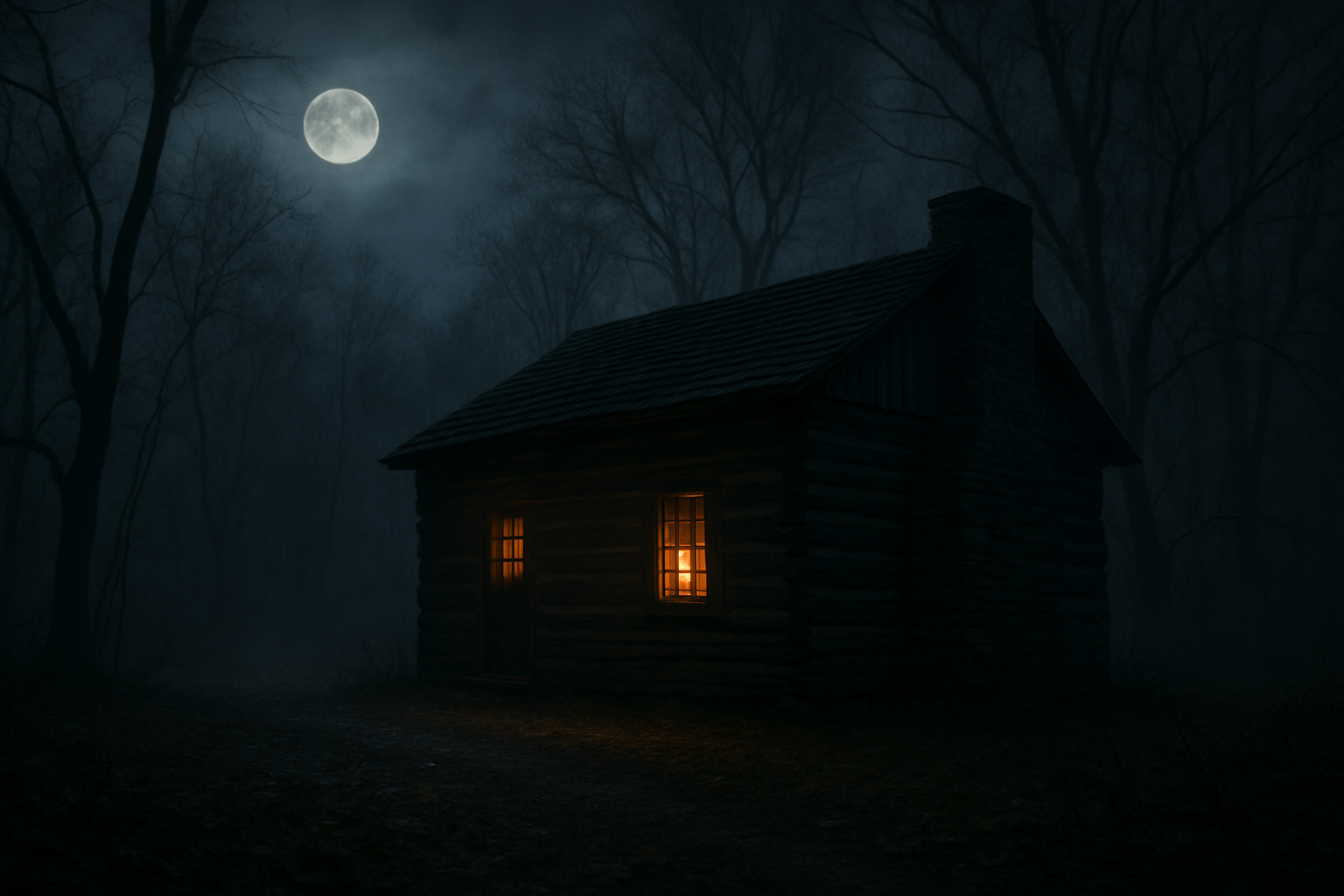
The Bell Witch: The Haunting of the Bell Farm 1817 to 1935
Tennessee's Most Documented Supernatural Case
Robertson County, Tennessee, 1817-1821
John Bell Sr arrived in Robertson County, Tennessee, in 1804 with ambitions that extended far beyond farming. The 54-year-old North Carolinian had purchased 320 acres of prime bottomland along the Red River, establishing what would become one of the region’s most prosperous agricultural enterprises. Bell eventually expanded his holdings to 398 acres and became one of the area’s most successful planters, while serving as an elder at the Red River Baptist Church.
The family consisted of John and his wife Lucy Williams Bell, along with their children Jesse, John Jr, Drewry, Benjamin, Esther, Zadok, Elizabeth (called Betsy), Richard Williams, and Joel Egbert. For thirteen years, the Bells lived peacefully in their new Tennessee home, accumulating both wealth and influence in the Red River settlement near present-day Adams.
How to support my work:
*Both books also available on Kindle Unlimited
Summer 1817: The First Sighting
In the summer of 1817, whilst inspecting his cornfields during a period of blight, John Bell encountered a creature unlike any he had seen before. The animal possessed the body of a large dog but bore the head of a rabbit, crouching motionless amongst the corn rows. Bell raised his musket and fired, but the beast vanished without trace. He dismissed the incident as an encounter with an unfamiliar woodland creature, unaware that this sighting marked the beginning of four years of documented supernatural activity.
Autumn 1817: The Disturbances Begin
The family’s troubles commenced with unexplained knocking on doors and windows, accompanied by the sound of wings flapping against ceilings and what appeared to be rats gnawing on bedposts. These initial disturbances occurred two or three times weekly, dismissed by the family as possible wildlife activity or the youthful pranks by the children.
The phenomena escalated dramatically. More disturbing sounds followed: choking and strangling noises, chains dragging across floors, and heavy objects striking surfaces, all emanating from within the house. Witnesses described sounds as if beds were suddenly and roughly pulled apart, accompanied by the noise of fighting dogs chained together, creating a deafening cacophony.
Despite thorough searches conducted with lit candles, no rats were found in the home and no damage to furniture was ever discovered. The family initially refused to discuss these occurrences with neighbours, hoping the disturbances would cease naturally.
Late 1817: Physical Manifestations
The invisible presence graduated from sound to attacks. Joel, Richard Williams, and especially Betsy were subjected to being struck, pinched, and having their hair pulled relentlessly. The children were pulled from their beds, and unseen hands pinched and slapped the family. Most of the phantom abuse was centred on Betsy, John Bell’s daughter, and John Bell himself.
John Bell confided first in his wife, then in his neighbour James Johnson, seeking rational explanations for the mounting disturbances. Johnson advised Bell to seek assistance from others in the community, suggesting they invite witnesses to observe the phenomena and offer solutions. Bell, though reluctant to publicise his family’s troubles, grew desperate enough to accept visitors who might help rid them of their tormentor.
1818: The Voice Emerges
Faint vocal manifestations such as whistling and whispering began to accompany the physical disturbances. By 1818, these evolved into a weak, faltering voice that gradually strengthened into distinct speech. The entity demonstrated remarkable abilities, mimicking pious recitations, repeating word-for-word a neighbour’s prayer and hymn, along with laughter, singing, and profane language.
When questioned about its identity, the spirit provided various explanations. At times it claimed: “I am a Spirit; I once was very happy, but I have been disturbed and made unhappy. I am the Spirit of a person who was buried in the woods nearby and the grave was disturbed, my bones disinterred and scattered, and one of my teeth was lost under this house. I am here looking for that tooth.” On another occasion, it proclaimed to be “a Spirit from everywhere, Heaven, Hell, the earth; am in the air, the houses, any place at any time; have been created millions of years.”
Parallels in Another Case
Remarkably, these patterns of behaviour would repeat almost exactly 160 years later in the Enfield poltergeist case: an entity that conversed freely with investigators, provided multiple contradictory identities, and physically attacked an adolescent girl whilst her family watched helplessly. The similarities are so striking they suggest either genuine recurring phenomena or that certain conditions reliably produce identical narratives. If you have not read my article on the Enfield poltergeist, the parallels between these cases separated by more than a century are extraordinary.
The Enfield Poltergeist: Britain's Most Documented Haunting
Classification: Unexplained Phenomena – Poltergeist Activity
1819: Kate Batts’ Witch
The entity eventually identified itself as “Old Kate Batts’ witch” and responded favourably to being called Kate. Mary Catherine “Kate” Batts was indeed a real neighbour of the Bells, a widowed merchant known for her fiery temper who had disputed a land transaction with John Bell in 1817 involving slaves and property lines. Kate Batts was reported to be one of Lucy Bell’s nieces and was seen as odd and suspicious by Adams residents.
The entity’s behaviour revealed distinct preferences and animosities. The Bell Witch seemed to like some members of the family whilst despising others. She wouldn’t touch John Jr, and she went out of her way to help Lucy, even singing to her when she was sick. In stark contrast, Betsy, by all accounts, received the most violent and unending treatment.
The entity had two declared objectives for visiting the Bell home: to kill John Bell and to prevent his youngest daughter Betsy from marrying Joshua Gardner, a neighbour boy to whom she had become engaged.
1819: Public Attention and Notable Visitors
Word of the talking entity spread throughout the region, drawing hundreds of curiosity seekers to the Bell farm. Among these visitors was General Andrew Jackson in 1819, who owned multiple parcels near Red River and had visited the area several times. Three of John Bell’s sons had fought under Jackson, against the British, at the Battle of New Orleans, providing a personal connection to the future president.
According to accounts recorded decades later, Jackson’s wagon became stuck despite considerable effort by his men to free it, prompting Jackson to exclaim, “By the eternal, boys, it is the witch.” A metallic voice was heard in the vegetation: “All right General, let the wagon move on, I will see you again tonight.” Among Jackson’s party was allegedly a ‘witch layer’ who boasted of his supernatural exploits. When the entity arrived and taunted the man to shoot, his gun would not fire. The witch countered, “I’ll teach you a lesson,” and appeared to beat the man and lead him out the door by his nose.
Jackson was reportedly eager to stay and witness more phenomena, but his party had experienced enough and Jackson returned to Nashville shortly thereafter. The future president supposedly declared he would “rather face the entire British Army than spend another night with the Bell Witch.”
1819-1820: John Bell’s Decline
As the haunting continued, John Bell began experiencing strange medical symptoms that appeared neurological in nature. He suffered from dysphagia, a discomfort in swallowing, and facial paralysis that progressively worsened. His mouth became paralysed to the point where he could barely speak. The entity would hurl insults at John Bell with apparent malice, regularly referring to him as “Old Jack” whilst vowing his destruction.
December 19-20, 1820: The Death of John Bell
On December 19, 1820, John Bell failed to leave his bed. When John Jr went to the cupboard to retrieve medicine for his father’s care, instead of the usual three medicine vials, he found only one. It was one-third full of a dark, smoky liquid of unknown origin.
The voice of the witch immediately gloated: “It’s useless for you to try to relieve Old Jack. I have got him this time; he will never get up from that bed again!” She claimed of the vial that she had “gave Old Jack a big dose of it last night while he was fast asleep, which fixed him.”
To test the mysterious liquid, Alex Gunn and John Bell Jr administered a drop to the family cat using a straw. The cat died within moments. John Bell died the following day, December 20, 1820, at the age of 70.
When the contents of the vial were thrown into the fire, they erupted into a bright blue blaze. Modern chemical analysis suggests this blue flame points toward arsenic poisoning, as arsenic produces exactly this colour when burned. Witnesses also reported the smell of garlic on John’s breath as he was dying, another symptom consistent with arsenic poisoning.
The Bell Witch crashed the funeral, disrupting the service and singing bawdy drinking songs until the last mourners had passed through the graveyard gates. John Bell’s death marked him as the first person in American history recorded as being killed by a spirit, making Tennessee the only state in the nation to officially recognise a death caused by a supernatural entity.
1821: The End of Betsy’s Engagement
Following John Bell’s death, the entity intensified its focus on preventing Betsy’s marriage to Joshua Gardner. The tormenting became so severe that Betsy, unable to endure the constant harassment, called off her engagement in March 1821.
With both declared objectives accomplished, John Bell’s death and the termination of Betsy’s engagement, the entity announced its departure. Before leaving, it promised to return in seven years, in 1828, and made a further prediction that it would return again in 1935.
1828: The Brief Return
The spirit returned as promised in 1828, manifesting to Lucy and her sons Richard and Joel with similar activities as before. However, the family chose not to encourage the phenomena, and the witch appeared to leave again after a brief period. The entity claimed it would return once more in 1935, exactly 107 years later.
1935: The Final Return
Local farmers and journalists reported eerie phenomena near the Bell Witch Cave in 1937, including cold spots, whispers of “Kate’s back”, and fleeting glimpses of a shadowy woman. Louis Garrison, who owned the farm that included the Bell Witch Cave, heard unexplained noises coming from inside the cavern. Bell descendants described the sound of something rubbing against the house, a paper-like object that flew out one door and re-entered through another, and faint music heard from a piano. However, no widespread haunting materialised, disappointing those anticipating a dramatic return. The phenomena lasted only a few weeks before subsiding completely.
The Documentary Legacy
The Bell Witch case might have faded into local folklore without the efforts of Martin Van Buren Ingram, a newspaper editor born in Kentucky in 1832. Ingram served in the Confederate Nashville Battalion during the Civil War until an injury at the Battle of Shiloh resulted in his discharge. He subsequently pursued a career in editing and publishing, working in the newspaper industry until 1881.
In 1894, Ingram published “An Authenticated History of the Famous Bell Witch,” widely regarded as the first full-length record of the legend. The book contains what Ingram claimed was the full text of “Our Family Troubles,” the purported diary of Richard Williams Bell, as well as interviews with descendants and contemporary witnesses. Ingram stated he had received the manuscript from James Allen Bell, a grandson of John Bell, who had preserved his father’s account.
Legacy
The Bell Witch case stands as one of the most documented hauntings in American history. When John Bell died in 1820, Kate Batts was still alive and lived for many years afterward, adding another layer of mystery to theories about her connection to the haunting.
Some modern researchers have offered alternative explanations for John Bell’s death. Dr Meagan Mann, a chemistry professor at Austin Peay State University, has noted that John Bell’s symptoms, facial paralysis, difficulty swallowing, neurological distress, align with chronic arsenic exposure, and the blue flame when the mysterious vial was burned strongly suggests arsenic was indeed present.
The Bell family continued to prosper despite what they termed “Our Family Trouble.” Some descendants still live in Tennessee and other Southern states. The original Bell house no longer stands, but the Historic Bell Witch Cave in Adams, Tennessee, preserves artifacts from the original Bell cabin, including a chimney stone and an iron kettle.
The Bell Witch case has become deeply embedded in American folklore. The story has inspired countless books, documentaries, and films, including loose adaptations such as “The Blair Witch Project” and “An American Haunting.” Visitors continue to report unusual phenomena at the cave and surrounding farmland, ensuring the Bell Witch remains America’s most enduring supernatural legend.
The case occurred during a period when Tennessee was transitioning from wilderness to settled society, when frontier families faced isolation and hardship in an untamed landscape. The Bell family’s ordeal, documented by multiple witnesses over four years, continues to captivate and confound more than two centuries later.


interesting tale, though it’s hard not to be suspicious of John’s children who weren’t affected, or possibly a neighbor or slave who might have had it out for Bell and Betsy.
I love this story. I actually gave a Bell Witch t-shirt. Yep, I’m THAT guy. lol! Thanks for sharing!