The Bold Street Time Slip
A Liverpool Time Slip, 1996
Dear reader, where I believe it helpful, I have included links to companies, places, and key terminology within the body of this text. Keep an eye out for underscored words, as they will take you directly to source material webpages and provide additional context where needed.
In October 1996, an off-duty Liverpool police officer, publicly known as Frank, was shopping on Bold Street with his wife. At the time, he was a serving officer, trained to observe detail and record events accurately. Bold Street was a central retail thoroughfare in Liverpool, running down towards Church Street, and was busy on weekend afternoons with shoppers, buses, and delivery vehicles.
The couple separated briefly while browsing. In the version of events most often recorded, Frank had stepped into a nearby music shop while his wife continued ahead towards Dillons, the bookshop that occupied premises on Bold Street during the 1990s. They arranged to meet moments later.
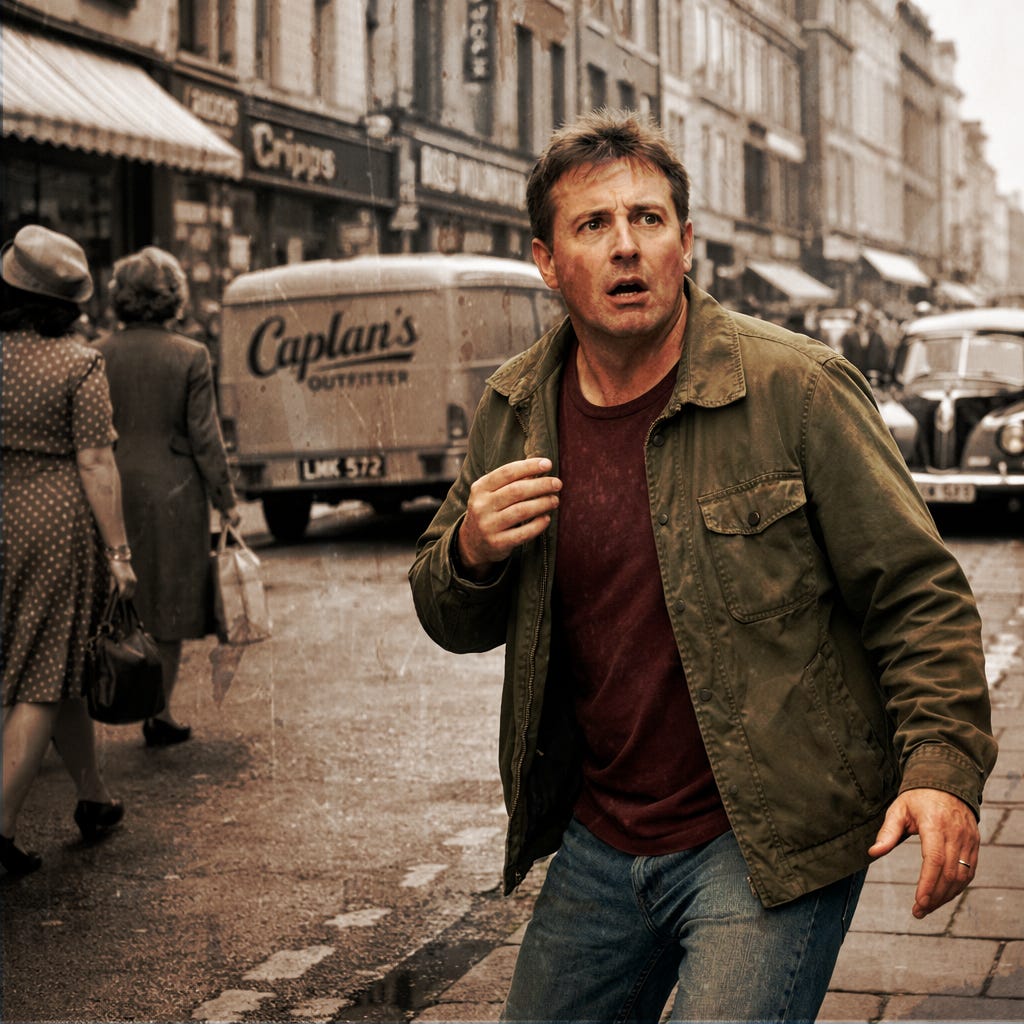
When Frank left the music shop and walked along the street to rejoin her, he noticed a sudden change in his surroundings. The noise of traffic seemed muted. A small delivery van in a style consistent with the 1950s drove past him. He looked up at the frontage where he expected to see Dillons. The bookshop was gone.
In its place stood a women’s clothing shop bearing the name Cripps, a business that had traded on Bold Street decades earlier, but Frank was unaware of this at the time. The street scene matched the shopfront. Cars appeared older in design, with rounded bodywork and chrome trim. Pedestrians wore clothing that reflected mid-twentieth-century fashion. The change occurred within the short distance it had taken him to walk along the pavement.
Get Extra Content and Support My Work
Paid subscribers receive one exclusive investigative case file every week, featuring extended witness testimony, deeper research and material that does not appear publicly. Membership also unlocks the complete archive of more than 150 paid case files.
You can take a sneak peek at a paid article by claiming a complimentary paid article at any time, no commitment required, open the article and claim it.
Membership is £3.50 per month, about $4.49 USD, which works out at 87p per article, about $1.10 USD.
An annual plan is £35, about $44.50 USD, reducing the monthly cost to £2.90, about $3.68 USD, a 16.7% saving.
A group plan for two or more people offers a further 20% discount. If you value documented evidence and serious investigation, this is how you access the full archive and support the work.
Frank moved towards the frontage where Dillons should have stood. The sign above the door read Cripps. He later understood this to have been a women’s clothing retailer that had occupied premises on Bold Street decades earlier. At the time, he experienced it as present and operational.
The exterior matched the name. The window display featured garments consistent with mid-twentieth-century fashion. The mannequins wore tailored coats and dresses cut in a style no longer common in 1996. Pricing cards were printed in a format that reflected pre-decimal currency.
He paused briefly, aware that the shop did not belong to the decade he had left moments before. The street behind him continued to reflect the same earlier period. Vehicles and pedestrians showed no sign of anomaly within that environment. The scene appeared coherent.
He opened the door and entered.
Inside, the layout reflected a traditional clothing retailer. Racks of women’s garments were arranged in orderly rows. The fabrics and cuts corresponded with the styles visible in the window. The lighting was softer than in modern retail units. The décor lacked contemporary branding or promotional material. He observed other customers browsing. Staff stood behind a counter in attire that matched the period suggested by the street outside.
Frank later stated that the interior felt solid and physical. He was not observing from a distance. He was inside the premises, moving through it. As he became more conscious of his surroundings, he also became aware of himself. His own clothing, typical of the mid-1990s, did not align with the garments around him. The realisation intensified the sense that he was out of place in a functioning environment that no longer corresponded to 1996.
While inside the shop, Frank became increasingly aware of the attention. In later accounts, he described a woman nearby who looked at him in a manner he interpreted as confusion or concern. He believed his clothing marked him as out of place. The garments worn by other customers and staff reflected the mid-twentieth-century setting suggested by the street outside. His own appearance reflected 1996.
He remained only a short time. He did not attempt conversation. The environment appeared internally consistent, with no sign of disruption from those within it.
The realisation intensified quickly. He described a physical unease. The shop was solid, the fixtures tangible, yet he recognised that his presence was out of alignment with the time and reality. He turned and walked towards the exit.
As he stepped back through the doorway and onto Bold Street, the environment altered immediately. The women’s clothing shop was gone. In its place stood Dillons, the bookshop that occupied the premises in 1996. The vehicles on the street were modern. The clothin’ clothing matched the decade. The usual sound of traffic and city movement returned without transition.
When he rejoined his wife, she had noticed nothing unusual. She had walked towards the bookshop as planned and saw Dillons in its place throughout. There had been no change in traffic, no alteration in the street. From her perspective, only a short interval had passed.
Frank later estimated that the episode lasted a matter of minutes. There was no measurable gap in time. The event concluded as abruptly as it began.
Press Coverage
Before the era of viral internet circulation, unusual accounts moved through local radio and the regional press. The Bold Street incident came to light when Liverpool author Tom Slemen recounted the experience on a Merseyside radio programme hosted by Billy Butler and Wally Scott. Listeners responded. In the days that followed, a newspaper letter referenced the broadcast and stated that a women’s clothing store named Cripps had indeed traded on Bold Street during the late 1950s and 1960s. The writer recalled the shop from personal memory. The detail that had appeared in Frank’s account was not unfamiliar to those who had known the street decades earlier.
More Time Slips on Bold Street
Frank’s account did not remain isolated. In the years that followed, Bold Street acquired a reputation within local folklore for similar episodes.
One earlier case often cited occurred in 1993 and involved a woman who reported seeing the street revert to a wartime setting. She described buildings bearing bomb damage and a general atmosphere consistent with the Second World War. The shift was brief and confined to her perspective.
Another report, also discussed in local broadcasts and later writings, described a couple who claimed to have stepped into a 1960s version of Bold Street while searching for a record shop. They reported older vehicles, period clothing, and shopfronts that matched those of earlier decades before the scene returned to normal.
These accounts share structural similarities. The experiences are brief. They occur in daylight. The environment appears coherent while altered. The reversion is immediate. There is no documented physical evidence beyond testimony.
Bold Street itself is not architecturally ancient. It is a commercial street that has undergone steady redevelopment across the twentieth century. Archival photographs confirm that its shopfronts, signage and traffic patterns have changed repeatedly over decades. The time slip narratives draw directly from those historical layers.
Taken together, the reports form a small cluster attached to a single urban location. Whether interpreted as misperception, memory overlay or something less easily categorised, Bold Street has become one of the United Kingdom’s most frequently cited urban time slip sites.


Presumably it's a second-hand record shop?