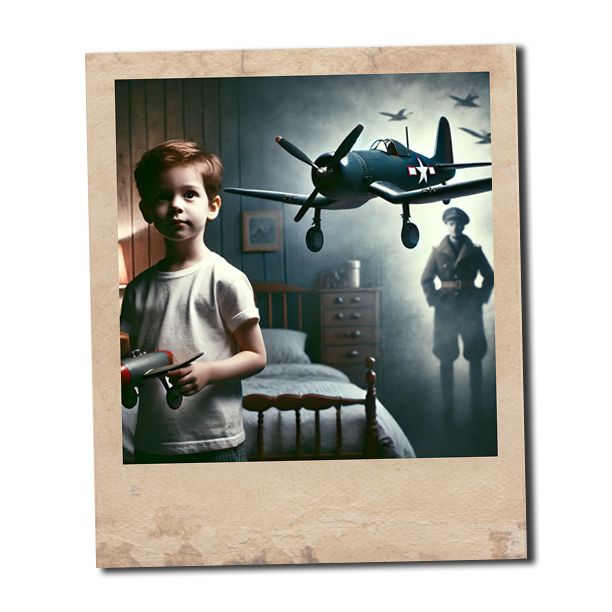
The James Leininger Case: A Louisiana Boy’s Wartime Memories
A documented account of past-life recollections from World War II
In the spring of 2000, in a quiet suburban home in Lafayette, Louisiana, a family’s life took an extraordinary turn. James Madison Leininger, barely two years old, began experiencing violent nightmares that would catapult his parents into years of investigation, ultimately leading them to conclude their toddler was reliving memories from a World War II fighter pilot’s final moments.
What began as typical childhood night terrors evolved into a meticulously documented case that would challenge conventional understanding of memory, consciousness, and identity. The boy’s statements, recorded before any historical research began, would eventually align with the documented life and death of Lieutenant James McCready Huston Jr., a 21-year-old Navy pilot killed in action near Iwo Jima on 3 March 1945.
How to support my work:
*Both books also available on Kindle Unlimited
The Family
Bruce Leininger worked as a human resources executive for an oil industry company, whilst Andrea, a former professional dancer, managed their home and freelance resume writing business. They had moved from the San Francisco Bay area to Louisiana when Bruce accepted his position with the petroleum firm. At 40, Bruce was twelve years older than Andrea, and this was the couple’s first child together, though Bruce had four children from a previous marriage.
Both parents described themselves as conventional Protestant Christians. Bruce, in particular, held firm evangelical beliefs that would later be severely tested by his son’s experiences. The family lived comfortably in Lafayette, maintaining what they considered an ordinary American suburban existence until James reached his second birthday.
James Madison Leininger was born on 10 April 1998 in San Francisco. The family relocated to Dallas, Texas, when James was an infant, then settled permanently in Lafayette when he was 22 months old. By all accounts, James developed normally through his first two years, displaying typical toddler behaviour with no unusual interests or preoccupations.
The Cavanaugh Flight Museum
The first documented incident occurred when James was 22 months old. His father took him to the Cavanaugh Flight Museum in Dallas during a family visit. The museum houses an extensive collection of vintage military aircraft, with particular emphasis on World War II fighters and bombers.
Bruce later recalled that James became transfixed by the wartime aircraft displays. The toddler spent nearly three hours examining the planes, refusing to leave when the visit concluded. His fascination appeared particularly intense when viewing the World War II section, though at the time his parents attributed this to normal childhood interest in large, colourful machines.
From the museum gift shop, Bruce purchased several toy aeroplanes and a Blue Angels flight demonstration video for James. The child would watch this video repeatedly in the coming months, though the Blue Angels flew modern jets rather than World War II fighters.
The Drop Tank
The most remarkable incident occurred shortly after the family’s move to Lafayette in March 2000. Andrea was decorating their new home when she visited a Hobby Lobby store with James. She pulled a toy propeller plane from a display bin and handed it to her son, commenting, “Look, there’s even a bomb underneath it.”
James, not yet two years old, corrected her immediately: “That’s not a bomb, Mommy. That’s a dwop tank.”
Andrea had never heard the term “drop tank” before. When she later discussed the incident with Bruce, he explained that a drop tank was an external fuel tank fitted to aircraft to extend their operational range. The precision of James’s correction troubled both parents. At 23 months old, James possessed no conceivable source for such specialised aviation knowledge. The term did not appear in the Blue Angels video he watched, nor in any children’s books or television programmes the family consumed.
This incident marked the beginning of James’s demonstration of inexplicable technical knowledge about military aviation that would continue to perplex his parents and eventually drive them toward a remarkable investigation.

The Nightmares Begin
Approximately three months after the museum visit, James began experiencing severe nightmares. These were not ordinary childhood bad dreams. The episodes were characterised by violent thrashing, screaming, and what appeared to be physical re-enactment of specific scenarios.
During these episodes, James would kick his legs upward whilst lying on his back, as though attempting to escape from a confined space. He screamed phrases that initially seemed like gibberish but gradually became more distinct. Andrea, who typically handled nighttime disruptions, began documenting what James said during these terrifying episodes.
The most consistent and disturbing phrase was: “Aeroplane crash on fire! Little man can’t get out!” James repeated this with desperate urgency, sometimes for extended periods before finally settling back to sleep. The nightmares occurred several times weekly and showed no signs of diminishing with conventional soothing techniques.
What distinguished these episodes from typical night terrors was their consistent content and James’s apparent retention of specific details. Rather than forgetting the dreams upon awakening, James began discussing elements of his nightmares during daylight hours, treating them as memories rather than dreams.
The Details Emerge
As the nightmares continued, James began providing specific details about his experiences. He insisted his name was also James, and that he had been a pilot whose plane was shot down by the Japanese. When asked about his aircraft, James consistently mentioned flying something called a “Corsair” from a boat.
The boy displayed knowledge that seemed impossible for a two-year-old. He stated that Corsairs had a tendency to veer left during takeoff and frequently suffered tyre blowouts when landing. He knew that American forces assigned masculine names to Japanese fighter aircraft and feminine names to Japanese bombers. When shown pictures of various aircraft, James could identify specific World War II models with startling accuracy.
Most remarkably, James provided the name of the vessel from which he claimed to fly: the Natoma. He also mentioned a friend named Jack Larsen who was present when his plane was shot down. When Bruce obtained a book about Pacific Theatre aircraft carriers and was leafing through it with James, they reached a section on the Battle of Iwo Jima. James immediately pointed to a map showing Chichi-jima, picked a specific spot, and declared, “Daddy, this is where my plane was shot down.” The precision of this statement proved particularly significant when later research revealed that James Huston had indeed been killed during a strike against Japanese transport vessels near Chichi-jima, rather than at Iwo Jima itself.
James began signing his artwork “James 3,” explaining that he was “the third James” in a series. His drawings consistently featured scenes of aerial combat, crashed aeroplanes, and explosions, despite having no known exposure to war imagery beyond the museum visit.
The Investigation Begins
Bruce Leininger found himself in an increasingly uncomfortable position. His evangelical Christian beliefs provided no framework for understanding his son’s experiences, and he initially sought to disprove what James was claiming. However, his methodical corporate background compelled him to research the specific details James provided.
Internet searches revealed that the USS Natoma Bay was indeed a real World War II aircraft carrier that operated in the Pacific Theatre. The vessel participated in major operations including the invasion of Iwo Jima, precisely as James had indicated. This discovery forced Bruce to take his son’s statements more seriously.
Meanwhile, Andrea contacted Carol Bowman, a regression therapist who had written about childhood past-life memories. Bowman suggested techniques for addressing the nightmares, primarily involving reassurance that the traumatic events belonged to the past and that James was safe in his current life. This approach significantly reduced the frequency and intensity of the nightmares.
Bruce obtained a book about Pacific Theatre aircraft carriers and was leafing through it with James when they reached a section on the Battle of Iwo Jima. James immediately pointed to a map of the island and declared, “That’s where my plane was shot down.” The precision of this statement, combined with James’s inability to read, deeply troubled his father.
Finding Jack Larsen
Bruce’s research led him to contact Natoma Bay veterans’ organisations. Through correspondence with Leo Pyatt, an officer of the Natoma Bay Association, he learned that the ship’s crew held regular reunions. The veterans proved remarkably receptive to his enquiries, despite the unusual nature of his investigation.
In September 2002, Bruce travelled alone to San Diego for his first Natoma Bay reunion. He approached the gathering with considerable apprehension, uncertain how wartime veterans would react to claims that his toddler son possessed memories of their fallen comrade.
The reunion proved revelatory. Bruce learned that eighteen aircraft carrier pilots from the Natoma Bay had died during Pacific operations. Among them was James McCready Huston Jr., the only pilot from the squadron killed during the Iwo Jima operation. When Bruce explained his son’s specific statements about Corsair aircraft characteristics, the veterans confirmed details that astounded him.
They verified that Corsair fighters did indeed have tendencies to veer left during takeoff and frequently suffered landing gear problems upon landing. The veterans also confirmed that crew members typically referred to their vessel as “the Natoma” rather than using its full designation “Natoma Bay” - precisely as James had stated.
Most significantly, Bruce located Jack Larsen, who was still alive and living in Arkansas. Larsen had indeed served aboard the Natoma Bay and flown alongside Huston, confirming James’s mention of this friendship. However, Larsen had survived the war, which initially seemed to contradict James’s narrative about his friend being present when his plane was shot down.
The veterans’ acceptance of Bruce’s investigation surprised him. Rather than dismissing his claims, they showed genuine interest in helping verify the details James had provided. Their willingness to share memories and records would prove crucial to the unfolding investigation.
James McCready Huston Jr
The breakthrough came when Bruce learned that among the Natoma Bay’s casualties was a pilot named James McCready Huston Jr. Military records indicated that Huston was the only pilot from the carrier’s squadron killed during the Iwo Jima operation. He died on 3 March 1945, at age 21, when his FM-2 Wildcat was struck by anti-aircraft fire.
Huston’s aircraft was indeed shot down near Chichi-jima, precisely as James had indicated when pointing to the map months earlier. The strike mission targeted Japanese transport vessels near this island approximately 150 miles north of Iwo Jima. Eyewitness accounts from fellow pilots described the plane exploding in flames before crashing into the Pacific. The cockpit canopy appeared to jam, preventing Huston from escaping the burning aircraft.
Ralph Clarbour, a rear gunner flying alongside Huston during the fatal mission, provided detailed testimony about the crash. His account precisely matched James’s description of being “hit in the engine” and trapped in a burning cockpit. Jack Larsen had indeed been present during this mission, flying nearby when Huston was shot down.
The correspondence between James’s statements and Huston’s documented death was remarkably specific. However, one discrepancy emerged: Huston was flying an FM-2 Wildcat when killed, not a Corsair as James consistently claimed. This anomaly would later be addressed through additional research.
The Corsair Connection
The discrepancy regarding aircraft type troubled investigators until Bruce located Huston’s surviving sister, Anne Huston Barron. During their correspondence, she provided family photographs and personal effects from her brother’s military service.
Among these materials was a photograph showing James Huston standing beside a Corsair fighter aircraft. This image confirmed that whilst Huston died flying a Wildcat, he had indeed flown Corsairs during his training and earlier operational periods. The photograph validated James’s consistent references to Corsair characteristics.
Anne Barron became convinced of the connection between her deceased brother and the Louisiana boy. She provided James with family mementos, including military decorations and personal photographs. The elderly woman reported feeling a profound sense of closure through her interactions with the child.
Personal Verification
Andrea’s research into James Huston’s family led her to locate his surviving sister, Anne Huston Barron, who was living in California at age 84. When Andrea contacted her and arranged a telephone conversation with James, the boy demonstrated knowledge of intimate family details that had never been published or discussed publicly.
When James spoke directly with Anne Huston Barron by telephone, he demonstrated knowledge of intimate family details that had never been published or discussed publicly. He addressed her as “Annie,” which had been her brother’s nickname for her. James accurately described their father’s alcoholism and violent behaviour when intoxicated, including specific incidents of property destruction.
James also mentioned three names: Billy, Leon, and Walter, which he previously used for his toy soldiers. Research revealed these corresponded to Billie Peeler, Leon Connor, and Walter Devlin, three Natoma Bay pilots who had died in service before Huston’s death. James claimed these figures were “waiting for him in heaven,” suggesting a narrative continuation beyond the crash.
At a Natoma Bay memorial dedication, James recognised Bob Greenwald, one of Huston’s former squadron mates, immediately upon meeting him. Veterans present commented on physical resemblances between the boy and photographs of the young pilot, though such observations remain subjective.
The Anniversary Effect
A particularly striking occurrence happened on 3 March 2003. James, whose nightmares had largely subsided, suddenly experienced another intense episode involving plane crashes and fire. This date corresponded exactly to the 58th anniversary of James Huston’s death, though Bruce had not yet determined the precise date of the pilot’s demise.
The timing of this nightmare, occurring before the family knew its significance, impressed even sceptical observers. When Bruce later researched military records and discovered the date match, it provided additional circumstantial support for the connection between the two James figures.
Documentation and Public Response
The case gained significant attention when ABC News produced a television segment featuring the family in 2004. Crucially, this interview was conducted before James Huston had been identified, documenting the boy’s statements independently of any known historical figure. The programme never aired initially, but copies were retained by researchers.
Dr Jim Tucker of the University of Virginia’s Division of Perceptual Studies investigated the case formally, publishing academic papers in peer-reviewed journals. Tucker noted that the family maintained dated internet searches and correspondence that proved their investigation timeline. These documents demonstrated that James’s statements preceded any knowledge of Huston’s existence.
In 2009, Bruce and Andrea Leininger published ‘Soul Survivor: The Reincarnation of a World War II Fighter Pilot,’ co-authored with writer Ken Gross. The book became a bestseller and sparked international discussion about childhood memory phenomena, though it also attracted significant criticism from sceptical researchers.
See my article dedicated to the Virginia’s Division of Perceptual Studies
🔎Paranormal Insights: The University Medical Institute That Studies Reincarnation and the Afterlife
Visit the DOPS Website: https://med.virginia.edu/perceptual-studies/
Resolution and Aftermath
By age eight, James’s nightmares had completely ceased. He retained some memories of his earlier experiences but developed normal childhood interests, including athletics and typical academic pursuits. The intense focus on aviation and wartime themes that characterised his early years gradually diminished.
Bruce Leininger’s investigation process fundamentally altered his religious beliefs, leading him to accept reincarnation as compatible with Christian faith. He established a memorial to Natoma Bay veterans at the Nimitz Museum in Fredericksburg, Texas, honouring the service members whose stories had become central to his family’s experience.
James, now an adult, has largely moved beyond the intense public attention his case generated. He completed his education and pursued conventional career paths, though he maintains awareness of his unusual childhood experiences. The nightmares and aviation obsessions that defined his early years became distant memories.
Anne Huston Barron maintained correspondence with the Leininger family until her death, convinced that she had reconnected with her brother through the Louisiana boy. She passed away believing that James Leininger carried authentic memories of James Huston’s final moments and family relationships.
Historical Background: The Battle of Iwo Jima
James McCready Huston Jr. died during Operation Detachment, the American assault on Iwo Jima that began on 19 February 1945. The USS Natoma Bay, designated CVE-62, was one of numerous escort carriers providing air support for the invasion. These smaller carriers operated close to combat zones, launching fighter and bomber missions against heavily fortified Japanese positions.
Huston’s final mission targeted Japanese transport vessels near Chichi-jima, part of ongoing efforts to disrupt enemy supply lines and reinforcement attempts. The anti-aircraft fire that killed him represented the intense defensive measures Japanese forces maintained throughout their Pacific island garrisons.
The young pilot’s death occurred just days before the Natoma Bay was scheduled to rotate back to American waters, making his loss particularly poignant for surviving crew members. His service record indicates this was his fiftieth combat mission, suggesting extensive operational experience despite his youth.
Assessment
The James Leininger case presents documented statements, witness testimony, and historical correlations that exceed typical anecdotal accounts. The family’s methodical investigation, combined with independent verification of military records and veteran testimony, created an unusually comprehensive evidentiary foundation.
Whether these correspondences indicate genuine past-life memory, extraordinary coincidence, or unrecognised information transfer remains a matter of interpretation. What cannot be disputed is that a Louisiana toddler provided specific details about a World War II pilot’s life and death that proved historically accurate.
The case contributed to ongoing academic research into childhood memory phenomena whilst demonstrating the profound impact such experiences can have on ordinary families. For the Leiningers, what began as disturbing nightmares evolved into a decade-long investigation that fundamentally altered their understanding of consciousness, memory, and human identity.
The documentation surrounding James Leininger’s experiences, regardless of their ultimate explanation, provides insight into how extraordinary claims can emerge from seemingly conventional circumstances and the lengths to which people will go to understand the inexplicable moments in their lives.


