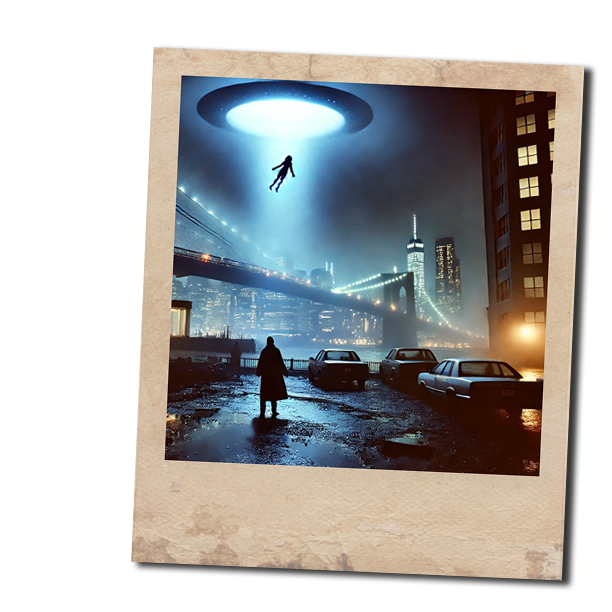
The Manhattan Alien Abduction: The Linda Napolitano Case
First hand accounts of what happened in Lower Manhattan, New York – 30th November 1989
Linda Napolitano lay asleep in her bed on the 12th floor of a red brick apartment building at 201 Cherry Street. The 41-year-old Italian-American housewife shared the two-bedroom flat with her husband Steve and their two young sons. Outside their bedroom window, the East River stretched toward Brooklyn. Below, the quiet streets of the Lower East Side held only the occasional late-night taxi.
At 3:15 AM, Linda awoke suddenly. Something felt.. off. A numbness crept through Napolitano’s entire body. was losing the ability to move her arms or legs. Steve slept peacefully beside her, his breathing steady and undisturbed.
With a chilling realisation, she noticed that four small figures stood at the foot of their bed.
How to support my work:
*Both books also available on Kindle Unlimited
The creatures possessed enormous heads that seemed far too large for their frail bodies and thin grey necks. Their almond shaped eyes were completely black and stretched across most of their faces.. They wore no clothing whatsoever. Their skin appeared smooth and unnaturally pale.
With growing terror, Napolitano discovered she could not scream. Her throat had seized completely. She tried desperately to shake Steve awake, but despite vigorous shaking by Linda, he would not wake. Summoning every ounce of strength, she managed to grab her pillow and hurl it at the nearest creature before the paralysis took hold completely.
The beings communicated with her but not with spoken language. Injecting thoughts directly into her mind, they conveyed the instructions “be quiet, don’t resist”. They lifted her rigid body into the air. Steve never stirred as his wife floated past him, through the bedroom door, across the living room, and straight through the closed window twelve storeys above the street.
The November air was bitter cold. Below, the brightly lit, yet empty streets of Manhattan stretched out in their usual amber glow. With mounting horror, Napolitano realised she was floating upward with the beings positioned around her like an escort.
A craft hovered above her apartment building. Witnesses would describe it as oval-shaped, its lights shifting from reddish-orange to white-blue. Green lights rotated around its edge like a deadly carnival ride. The craft opened from the bottom, splitting apart like a monstrous clamshell. A blue beam surrounded her and pulled her through the opening.
Inside, Napolitano found herself in what she could only describe as an examination room. Even under hypnosis weeks later, her descriptions remained frustratingly vague. She spoke of benches along walls, a hallway with sliding doors, banks of lights, and control panels. At the centre of the room sat a large examination table. Every instinct screamed at her to fight, to run, to do anything but comply, but for some calmly complying with every request. This mind paralysis held her captive. She placed herself on the cold, hard surface.
Under hypnosis weeks later, she would relive the terror: “I don’t want to get up on that table. They get me on the table anyway. They start saying things to me and I’m yelling. I can still yell.”
When her voice returned, she screamed at them with everything she had. One of the beings made harsh, guttural sounds: “Nobbyegg, hobbyegg. No kave kave kobbyegg no kave.” She understood they wanted her quiet. When she kept yelling, one of them put its hand over her mouth. The fingers were long and ice cold.
They examined her with clinical detachment. They collected samples. They probed her. Then one of them approached with a thin metallic device. It inserted the object into her nostril and pushing into her her head. The pain was immediate and overwhelming. She felt tissue tearing, felt something being placed or removed. The agony built until she lost consciousness.
The Return
She woke in her bed. Steve was still asleep. The window was closed and locked. The clock showed three hours had passed, though only minutes existed in her memory. She lay there trying to make sense of what had happened. It must have been a nightmare..
That morning, with growing dread, she found the lump on her nose. When she touched it, sharp pain shot through her face, and upon checking, her pillow bore a bloodstain from a nosebleed during the night.
The Earlier Warning
Seven months before that November night, Napolitano had written to Budd Hopkins. Hopkins was a New York-based artist who had become America’s most prominent alien abduction researcher. He specialised in cases exactly like hers and ran support groups for people who believed they’d had such experiences.
Her letter described something that had happened thirteen years earlier. She and Steve had spent a weekend in the Catskill Mountains. She’d woken with a nosebleed and the disturbing sense that something had occurred while she slept, although she could not remember. She knew it was traumatic, but it was like the memory was just out of reach or Intentionally obscured. Later, she noticed a bump near her nose. A doctor examined the X-ray and told her it was scar tissue from previous surgery. She insisted she’d never had surgery on her nose. He seemed puzzled but certain. The X-ray showed a small foreign object lodged in her nasal cavity.
Hopkins was interested immediately. Reports of nasal implants appeared frequently in abduction cases. He asked Napolitano to see a specialist. With shocking discovery, the specialist confirmed something was there. When he tried to remove it, the object had vanished. Only scar tissue and cartilage buildup remained.
Hopkins called this the “radiological smoking gun.” He invited Napolitano to attend his support group meetings. By November 1989, she was a regular participant.
The Hypnotic Sessions
Hopkins arranged the first regression session within days of the November 30th incident. Napolitano could remember fragments: waking to see the beings, the floating sensation, the examination room. The journey from her apartment to the craft remained lost.
Under hypnosis, the missing details emerged. She described being taken first to the living room, then floating through the closed window. The craft had opened like a clam to receive her. Inside, she’d seen the benches and hallway, the sliding doors, the examination room with its lights and controls.
Several professionals witnessed the sessions. Charles Strozier, a MacArthur prize-winning historian and psychoanalyst, found Napolitano compelling: “She was articulate in her feeling, and appealing in the sense that you got drawn into her story.” Gibbs Williams, a psychotherapist, agreed. “The lady is for real. She really was shaking. You can’t fake that.” He added a qualification: she could fake it if she was “psychopathic on an extreme level. And she’s no psychopath.”
Hopkins documented everything carefully. The case followed familiar patterns from other abduction reports: grey beings, medical examinations, missing time, nasal implants. Taken alone, Napolitano’s experience was striking but unremarkable in the broader context of Hopkins’s research.
That changed in February 1991.
The Letter from the Bodyguards
Fifteen months after the alleged abduction, Hopkins received a letter that would transform everything. Two men calling themselves Richard and Dan had written to him. They identified themselves as police officers who’d witnessed something extraordinary on November 30th, 1989.
They’d been parked beneath the FDR Drive near the Brooklyn Bridge around 3:00 AM. Their car had mysteriously stalled. Above an apartment building two or three blocks away, they saw a large disc-shaped object hovering in the air. Its lights shifted from bright reddish-orange to white-blue. Green lights rotated around its edge.
Then they saw something that defied explanation. A woman in a white nightgown was floating out of a window on the 12th floor. Three small creatures accompanied her. All four figures rose through the air in a beam of light toward the craft. Once inside, the object descended rapidly into the East River near Pier 17.
The letter expressed overwhelming guilt and distress. “We can’t live with ourselves” for not helping the woman, they wrote. They desperately wanted to know if Hopkins had any information about what happened to her.
With electrifying realisation, Hopkins saw that their description matched Napolitano’s account in every detail: the location, the time, the appearance of the craft, even the white nightgown she’d been wearing. For the first time in his decades of research, he had independent witnesses to an abduction. They had no connection to Napolitano. They’d come forward on their own, driven by what they’d seen.
In subsequent letters, Richard and Dan revised their story with startling new information. They weren’t police officers. They were security agents with CIA connections. On November 30th, they’d been working as bodyguards for a senior political figure visiting Manhattan. Their high-profile client had also witnessed the event from the back seat of the car.
Hopkins conducted what background checks he could. Both men appeared to work in close protection services. Their credentials seemed legitimate. As for their client, Hopkins came to believe it was Javier Pérez de Cuéllar, who had been serving as Secretary-General of the United Nations.
Hopkins told Napolitano that the witnesses might contact her. A few days later, she called him with astonishing news. Richard and Dan had visited her apartment. The reunion had been emotional, she said. They’d been relieved to find her alive. They spoke as though they’d known each other for years.
The Witnesses Multiply
Other witnesses began contacting Hopkins with accounts that sent chills down his spine. A woman calling herself Janet Kimble. While having no knowledge of Richard and Dan’s account, she also said her car had also stalled, this time on the Brooklyn Bridge in the early morning hours of November 30th. She’d seen the same scene Richard and Dan described. At the time, she thought she was watching a film crew shooting a science fiction movie. When she learned about Napolitano’s case, she came forward.
The vehicular failures were unnervingly consistent. Richard and Dan’s car had stalled beneath FDR Drive. Kimble’s car had stalled on the bridge. Hopkins noted that electrical interference was common in close encounter reports.
A total of 23 people eventually came forward with accounts of witnessing the abduction.
The Third Man
Hopkins believed he’d found the evidence that would finally prove the reality of alien abductions. If Pérez de Cuéllar would confirm publicly what he’d witnessed, the scientific community and government agencies would be forced to take the phenomenon seriously.
Hopkins met privately with Pérez de Cuéllar. The former Secretary-General confirmed he’d witnessed the event but said he could never make a public statement. If his private acknowledgment ever became public, he would deny it. His position made such an admission impossible.
The Government Angle
Richard and Dan’s involvement added sinister layers to the case. Hopkins discovered they weren’t just bodyguards. They had CIA connections. This raised disturbing questions about government knowledge of alien activity.
On April 29th, 1991, the case took a terrifying turn. Richard and Dan abducted Napolitano in broad daylight. She was walking near her apartment when Richard grabbed her and forced her into their car. For three and a half hours, they drove around Manhattan interrogating her about the November incident.
Did she know more about the aliens than she was revealing? Did she work for the government? Was she herself an extraterrestrial or hybrid? Dan became increasingly agitated as Napolitano insisted she had no answers. They made her remove her shoes to examine her feet. They said aliens lacked toes.
Napolitano reported the incident to Hopkins, not to the police.
During this period, Napolitano told Hopkins she felt under constant surveillance. She bought a gun. She wore a recording device whenever she left her apartment. She saw men in black suits following her. Surveillance vans parked near her building.
Letters from Richard and Dan warned Hopkins to stop investigating “the third man.” The letters spoke of threats to world peace. They discussed ecological dangers and suggested aliens had been involved in ending the Cold War. The tone grew increasingly paranoid.
Hopkins documented everything but never met Richard and Dan. He never learned their surnames. He verified their identities to the UN, but could not verify their CIA connections.
The Novel Nighteyes
In April 1989, seven months before Napolitano’s alleged abduction, Doubleday published a science fiction novel called “Nighteyes” by Garfield Reeves-Stevens.
With shocking similarity, the parallels were extraordinary. In “Nighteyes,” a woman named Sarah is abducted into a UFO hovering over her high-rise apartment building in New York City. Government agents Derek and Merril, initially on a stakeout during early morning hours, witness a UFO abduction. They kidnap the female protagonist Wendy, throwing her into a van. They take her to a safe house on the beach. Derek, an FBI agent, develops romantic feelings for Wendy. One of the government agents is hospitalised for emotional trauma. The protagonist contacts a prominent UFO abduction researcher in New York City named Charles Edward Starr, who has written books on the topic. Vans are used for surveillance throughout the novel.
The investigators documented over a dozen specific parallels between Napolitano’s account and plot elements from “Nighteyes.” These weren’t similarities in common abduction experiences like medical examinations or implants. They were specific narrative details: the New York City high-rise setting, the early morning timing, government agents with intelligence connections, kidnapping by those agents, beach house locations, romantic fixation, psychiatric hospitalisation, surveillance vans, a prominent New York-based UFO researcher.
The novel had been published eight months before Napolitano’s alleged abduction.
Media and Books
Hopkins first went public with the case in 1992, publishing articles in the MUFON UFO Journal. He presented the case at the July 1992 MUFON symposium. Napolitano appeared and spoke to the audience about her terrifying experience.
The case generated enormous interest. The Wall Street Journal, Omni, Paris Match, and the New York Times all covered it. Hopkins and Napolitano appeared on Inside Edition. The case became known as “The Brooklyn Bridge Abduction” or “The Manhattan Alien Abduction.”
In 1997, Hopkins published “Witnessed: The True Story of the Brooklyn Bridge Abduction.” The book used pseudonyms for everyone, including Napolitano, whom he called “Linda Cortile.” It presented the case as definitive proof of the physical reality of alien abductions. The multiple independent witnesses, the high-profile political figure, the corroborating details made this the most compelling abduction case in history, Hopkins argued.
Walter H. Andrus, International Director of the Mutual UFO Network, called it a “definitely authentic case of human abductions by aliens.” He described it as “the case of the century.”
Napolitano appeared on Ricki Lake’s show during the 1990s. In 2013, she gave an interview to Vanity Fair. “If I was hallucinating,” she said, “then the witnesses saw my hallucination. That sounds crazier than the whole abduction phenomenon.”
The Lawsuit
In October 2024, Netflix released “The Manhattan Alien Abduction,” a three-part series directed by Vivienne Perry and Daniel Vernon. The series presented both supporting and skeptical perspectives. It featured interviews with Napolitano and archival footage of Carol Rainey, Bud’s ex-wife’s
investigation. Rainey had died in 2023.
Two days before the premiere, with explosive timing, Napolitano filed suit in New York State Supreme Court. She named Netflix, multiple production companies, and the estate of Carol Rainey as defendants. Joining her were Peter Robbins, a colleague of Hopkins, and the estate of Hopkins himself, who had died in 2011.
The complaint alleged fraud, defamation, breach of good faith, and misrepresentation of character. Napolitano claimed Netflix had promised her story would be presented fairly with limited input from Rainey. Instead, Rainey’s skeptical perspective dominated. The lawsuit described Rainey as an “embittered, alcoholic ex-wife hell-bent on revenge” and claimed the documentary portrayed Napolitano as a fantasist and villain.
The attempt to block the release failed. The series aired as scheduled.
The Evidence Problem
The detailed investigation by Stefula, Butler, and Hansen raised fundamental questions about methodology. They interviewed Napolitano and visited the site. With alarming discovery, they found the New York Post loading bay operated all night, directly opposite where the craft allegedly hovered with blinding lights. No one there saw anything.
They questioned why Richard and Dan waited over a year to contact Hopkins if they felt such guilt. Why did their story change from police officers to CIA-connected bodyguards? Why would trained protective services abandon their client to watch a UFO? Why did they never meet Hopkins? Why couldn’t Hopkins verify their identities?
The timeline didn’t make sense either. Moving a UN Secretary-General through Manhattan requires extensive security coordination. Multiple checkpoints. Multiple personnel. Any problem like a stalled vehicle triggers immediate alerts across security networks. No such alerts had been documented for that night.
They questioned Napolitano’s decision to report the April 1991 kidnapping to Hopkins rather than police. A violent abduction in broad daylight by men claiming CIA connections typically warrants law enforcement involvement.
The investigators spoke with dignitary protection specialists who explained the implausibility of the scenario. The preplanning required for moving officials of Pérez de Cuéllar’s rank made the described events highly unlikely. They suggested Hopkins ask Richard and Dan technical questions using specialised protective services terminology to verify their claimed expertise. Hopkins never did.
The Family
Napolitano’s son Johnny appeared in the 2024 Netflix documentary, his face obscured. “I know my mom better than anyone else,” he said, “and I will tell you right now, there’s no way I believe she would want to make anything like this up.” He expressed reluctance to discuss the events after more than thirty years but maintained his mother’s honesty.
Her husband Steve remained largely absent from public discussion. He’d been sleeping beside his wife during the alleged abduction and recalled nothing. He remained married to Napolitano through the years that followed. Supporters saw this as evidence of his belief in her account. Skeptics noted his presence in bed throughout the event, combined with his complete lack of awareness, raised questions about the physical reality of what Napolitano described.
Where They Are Now
Linda Napolitano now lives in Soddy-Daisy, Tennessee, a small city near Chattanooga. She is 77 years old. She has never changed her story.
In interviews for the Netflix documentary, Napolitano maintained the absolute truth of her experience. She acknowledged that fabricating such an elaborate story would require someone who was “either a sociopath or a genius.” She insisted she was neither. She expressed frustration that skeptics couldn’t accept the reality of her experience. The existence of 23 witnesses, she said, made disbelief more irrational than belief.
Budd Hopkins died in August 2011 at age 80. Until his death, he maintained the Napolitano case represented the best evidence for the physical reality of alien abductions.
Carol Rainey died in September 2023. She’d spent her final years documenting what she believed was a fundamental failure of investigative rigour in Hopkins’s research. Her archival footage and interviews formed a central part of the Netflix documentary’s skeptical perspective.
The apartment building on Cherry Street still stands. The Brooklyn Bridge still crosses the East River. The New York Post loading bay still operates through the night. On quiet early mornings, if you stand near that location and look up at the 12th-floor windows, you can imagine the scene Linda Napolitano described: a woman in a white nightgown, floating through the November darkness, accompanied by three grey beings, rising toward an impossible craft hovering above Manhattan.
Whether that scene ever occurred outside the realm of human consciousness remains, more than three decades later, Linda Napolitano’s word against a world of skeptics.


